UK Job Application Order: Shortlist, Apply, Track, Follow Up
A practical sequence for UK job applications for international candidates: shortlist employers, apply, track everything, and follow up once.
Quick answer
One practical order for a UK job search is: shortlist, apply, track, follow up. Build a shortlist from the official register of licensed sponsors and read each advert before deciding whether to apply. Save a dated record of each completed application so you can review the process. If the employer has not given a timeline or said not to contact it, one brief follow-up may be appropriate after a reasonable interval. This is an adaptable workflow, not a formula for an interview, a job, sponsorship, or a visa.
Key takeaways
- Shortlisting comes first because it determines which applications receive
your time.
- Separate employer research from immigration research — the licence is one
question and your eligibility is a different one.
- Choose an application pace that leaves time to read and tailor each one.
- Track everything with dates; a log turns a search into a process.
- Follow the employer's stated contact process; where it permits enquiries, one
concise follow-up is usually enough.
- One order will not work for every person, role, or sector.
- A sponsor licence is permission to sponsor, not a promise to sponsor any role
or any person.
Why order matters
The cost of a disorganised search
A disorganised search makes it easy to duplicate an application, lose the wording of an advert, or forget when an employer said it would reply. A repeatable sequence gives each of those details a place to live.
An explicit order gives you four things: a place to put each idea, a way to avoid duplicate applications, a record you can review, and a trigger for the next action. None of those requires a special tool. They require a sequence you stick to.
The honest caveat
No order works for everyone. Sectors, employers, and recruitment processes differ. Treat the order below as a default you can adapt, not a rule that guarantees results. Nothing guarantees a job or a visa.
Step 1: shortlist employers and roles
Employer first, advert second
Starting with employers can keep the licence check separate from the vacancy check. The Register of Licensed Sponsors: Workers is the official list of organisations permitted to sponsor, and it is free and public Source: GOV.UK — Register of licensed sponsors: workers. Our guide to finding UK jobs that sponsor visas walks through building that shortlist from the register.
What to put on the shortlist
For each employer, note:
- The legal name, not just the brand.
- A line on why you are interested.
- Any roles you have seen.
- The date you last checked the register.
Keep the list to a size you will maintain. Its usefulness comes from checking and revisiting it, not from reaching an arbitrary number.
The relevance of the register
Recall what a register entry means: the employer is permitted to sponsor. It does not mean the employer will sponsor you, any role, or anyone. Use it to build the shortlist, then let the advert and the employer's own words tell you about the specific vacancy.
Read each advert before it leaves the shortlist
The core checks
Reading an advert before moving a role into the application queue can expose an obvious mismatch early. Our guide to reading a UK job advert sets out a full method. The essentials:
- Salary. Does the basic pay on offer plausibly meet the requirements
of the route that applies to you? If it is clearly below, the role probably does not work regardless of how well you fit it.
- Sponsorship wording. An explicit statement that the employer cannot
sponsor the role is clear. Wording about right to work varies, so read the full context and do not treat silence as either a yes or a no.
- The advertiser. If a recruitment agency posted the advert, the licence
question applies to the end employer, not the agency.
Distinguish employer research from immigration eligibility
These are two separate problems, and mixing them can produce unsupported conclusions.
- Employer research asks: does the named organisation appear for the
relevant route, and what does the advert say? The register answers the first question; the advert and employer may provide evidence about the second.
- Immigration eligibility asks: do you personally meet the requirements of
a route? The answer depends on your occupation, your salary, and your own circumstances, and it is a question for GOV.UK or a regulated adviser.
The shortlist handles employer research. Your own eligibility is a separate thing you check with authoritative sources for your specific situation — not by extrapolating from an advert.
Step 2: apply
Small, targeted batches
Choose a pace that leaves enough time to complete each application accurately. For each application:
- Tailor the CV and cover letter to the role's actual requirements. Our guide
to CV tailoring when sponsorship matters covers what to change and, just as importantly, what not to fabricate.
- Name the employer and one specific reason you fit in the cover letter.
- Save a copy of the advert and the exact wording you used.
Re-verify the shortlist at application time
The register is updated frequently. If time has passed since shortlisting, check the employer's entry again and note the date rather than assuming your earlier result is still current.
Step 3: track
The minimal tracking log
Tracking does not need to be elaborate. A spreadsheet or notes file with one row per application works. Useful columns:
| Employer | Role | Applied | Outcome | Follow-up due |
|---|
Fill it in when you apply. Later, the log will show what you recorded without requiring you to reconstruct it from memory.
What tracking is for
Tracking creates a process you can review. It shows which employers replied, which applications reached later stages, and where your time went. It can also help prevent duplicate applications and remind you of stated response dates.
What tracking cannot do
A tracker records facts. It does not tell you why an employer stayed silent, or change the outcome. Treat it as an instrument of memory and review, not as something that guarantees replies.
Step 4: follow up
Follow up once, do it well
First follow any timing or contact instructions in the advert or acknowledgement. If no timeline is given and the employer permits enquiries, one brief, polite follow-up after a reasonable interval can restate the role and application date and ask whether anything further is needed. Do not imply that a reply is owed.
Follow up on the milestones, not just the application
If you complete a test, attend an interview, or exchange further messages, follow any instructions about next steps. A brief acknowledgement can be appropriate, but it should not pressure the recipient or imply an outcome.
When to stop
After one unanswered follow-up, let it rest unless the employer invites further contact. Keep an accurate status in the tracker and consider any later vacancy on its own terms.
Fitting this into your wider calendar
Rhythm and timing
A search organised around the four steps benefits from a weekly rhythm: shortlist one day, apply in batches, update the tracker, and follow up on what is due. The schedule matters less than the loop — shortlist, apply, track, follow up — being complete each cycle. Our guide to the timing of a UK job search looks at hiring windows and sponsorship lead times.
Avoiding burnout
The loop is designed to be small and repeatable. Set a pace that fits the time you actually have, and reduce the batch size when reading, tailoring, or record keeping starts to slip. The objective is a process you can continue and review, not a weekly quota.
What to do inside each batch
The shortlist session
When you sit down to shortlist, work from your employer list, not only from a search feed. The register does not provide a sector field, so bring names from your industry research, check each organisation and route in the official file, then open the employer's careers page. Decisions here shape the work that follows.
Keep a copy of the slogan that guides the whole method: choose employers you could actually work for, on a route that could apply to you, at a salary that works. Every later step is easier when those three are true up front.
The application session
Batch your applications so you are in one headspace at a time. When you apply:
- Read the advert once more, looking for anything that changed since you
shortlisted it.
- Re-check the employer's register entry and note the date.
- Tailor the CV and cover letter to that role.
- Save the advert and a copy of what you sent.
Batching avoids the worst trap of a disorganised search: half-finished applications. If you are not completing each one properly, you are better off applying to fewer.
The review session
Once a week, read your tracker end to end. Look for:
- Applications overdue a follow-up.
- Employer patterns — do some reply and others never do?
- Roles you applied-twice or not-at-all.
- Anything you need to leave and re-approach fresh.
A weekly review is what turns a recorder into a process. Without it, tracking produces data no one reads.
Handling the outcome of an application
A reply of any kind is information
Whether the answer is an interview, a standard rejection, or no response, log only what you know. A rejection sometimes contains useful feedback; an unanswered application does not reveal why the employer did not reply. Avoid turning either result into a conclusion the evidence does not support.
After an interview
If you reach an interview, the four-step loop continues organically. Follow the milestone with one short thank-you and any requested material, keep the log current, and continue the rhythm you set. Do not pause every other step to wait on a single role.
After a rejection
Do not treat a single rejection as a verdict on the whole approach. Check the log: is this employer from a sector that replies less? Is the salary band I am targeting realistic for my level? Adjust the next batch and continue. The sequence exists so that a setback becomes an input, not a stop.
A worked example
The companies below are invented for illustration.
First review. As a data engineer targeting Birmingham, you build a shortlist from the register, keeping the organisation name shown for each entry and the route displayed. An employer with a different rating is marked for a check against the current GOV.UK licence-rating guidance, without guessing why.
Application session. You open the careers pages of several shortlisted employers. Two roles appear relevant and neither advert states that sponsorship is unavailable. You re-check the register entries and note the date. You then check the current official route guidance separately, tailor the applications, and log each submission.
Later review. One employer sends an automated acknowledgement but gives no decision. After following its contact instructions, you send one short enquiry. Another employer invites you to a first-round call. You attend, log only the known outcome, and continue reviewing the rest of the shortlist.
Next cycle. You review the log. Some applications remain pending, one has progressed, and another has closed. You use any specific employer feedback to improve the next application, but do not invent a reason where none was given. The loop stays the same while the evidence in the log becomes more useful.
What made this search reviewable was not the roles that progressed but the fact that every step was written down in the same order. Later, the record shows what happened and what remains unknown.
The relationship between the order and sponsorship
Where the sponsor licence sits in the sequence
The licence is a shortlist filter, checked in step one and re-verified before each application. It does not replace the other steps. A licence says an employer is permitted to sponsor; the employer decides whether it intends to sponsor a specific role. Whether the role and applicant meet a route's current requirements must be checked against authoritative guidance for the actual facts.
Building a shortlist from the register can organise employer research before you open individual adverts. The method is covered in more depth in our guide to finding employers that sponsor visas.
When the order meets your own eligibility
Because employer research and immigration eligibility are separate, you can run the whole loop while a separate, authoritative check on your own situation runs alongside it. The loop keeps you moving on what is in your control — choosing employers, applying well, tracking, following up — while GOV.UK guidance and, where appropriate, a regulated adviser handle what is specific to you.
Common mistakes
- Shortlisting adverts instead of employers, then restarting the search every
week.
- Confusing the employer's licence with your own eligibility.
- Applying without reading the advert, then discovering the salary does not
meet your route's requirements.
- Not tracking, then reapplying to the same role or forgetting follow-ups.
- Following up repeatedly despite instructions or no invitation to do so.
- Giving up on the sequence because a single week produced nothing.
The bottom line
Shortlist employers and roles, apply carefully, track completed applications with dates, and follow the employer's stated contact process. This order makes the search reviewable; it does not promise results, and no single order suits everyone. Keep employer research (is the employer permitted to sponsor?) separate from your own eligibility (do you meet the route's requirements for your circumstances?). This page is information, not immigration advice, and this site is not affiliated with the Home Office or GOV.UK. For your own case, use GOV.UK or a regulated immigration adviser.
Frequently asked questions
What order should I apply for UK jobs in?
Shortlist employers from the sponsor register, read each advert, apply to the genuine fits in careful batches, track every application with dates, and follow up once. Adapt it to your sector and circumstances.
Should I apply to lots of jobs or focus on a few?
There is no universal target. Choose a volume that leaves time to check the advert, tailor accurately, and keep the tracker current, then review the results without treating a small sample as proof.
What is the most important step?
The first useful step is shortlisting because it determines which roles receive your time. The later steps still matter, and the register cannot establish that a particular role or applicant qualifies.
Do I check the sponsor register before or after applying?
Check as part of shortlisting. If meaningful time passes or the application reaches a costly later stage, check the current file again and record the date.
Is employer research the same as checking my visa eligibility?
No. Employer research asks whether the employer can sponsor the role. Your eligibility depends on your own occupation, salary, and circumstances, and is a question for GOV.UK or a regulated adviser.
How many follow-ups should I send?
Follow the employer's stated process. If it permits enquiries and gives no timeline, one concise follow-up after a reasonable interval is a cautious default; further messages should respond to an invitation or a real milestone.
How long should I wait before following up?
Use any date stated by the employer. If none is given and enquiries are permitted, wait a reasonable interval for that recruitment process. There is no single timing rule across employers and sectors.
What should I track for each application?
The employer, the role, the date you applied, where you found it, the latest outcome, and when any follow-up is due. That is enough to review the search.
What if an employer does not reply?
Keep the log factual, follow the employer's contact instructions, and move on after one unanswered enquiry. No response explains neither the employer's reason nor the quality of your application.
Should I tailor my CV for every application?
For the applications you truly care about, yes — match the language of the role where your experience genuinely supports it. Do not fabricate keywords you cannot defend in an interview.
Can one order work for every person?
No. Sectors and employers move differently, and people have different schedules and circumstances. Use the four-step loop as a sensible default and adapt it.
Does following the order guarantee an interview?
No. Nothing guarantees results in a job search. The order supports consistent checks and records; it does not control employer decisions.
Where does a sponsor licence fit in the order?
It answers the employer question at shortlisting. It is permission to sponsor, not a promise to sponsor any role or any person, so treat it as an entry signal and let the advert and the employer answer the rest.
When should I check my own eligibility relative to applying?
The register does not answer personal eligibility. Use the current GOV.UK guidance to check the occupation, pay, and other route requirements, and use a regulated adviser for advice about your own circumstances.
Last reviewed 2026-08-09 by Visa Ready UK Editorial Team. Figures on this page are checked against GOV.UK on the review date. Rules, fees, and salary floors change — always confirm against GOV.UK before you act. Spotted an error?
Check the employer without leaving the job advert
- See the legal sponsor name, town, routes, rating, and close matches on the page.
- Your checks and job-page text stay on your computer; the extension makes no network requests.
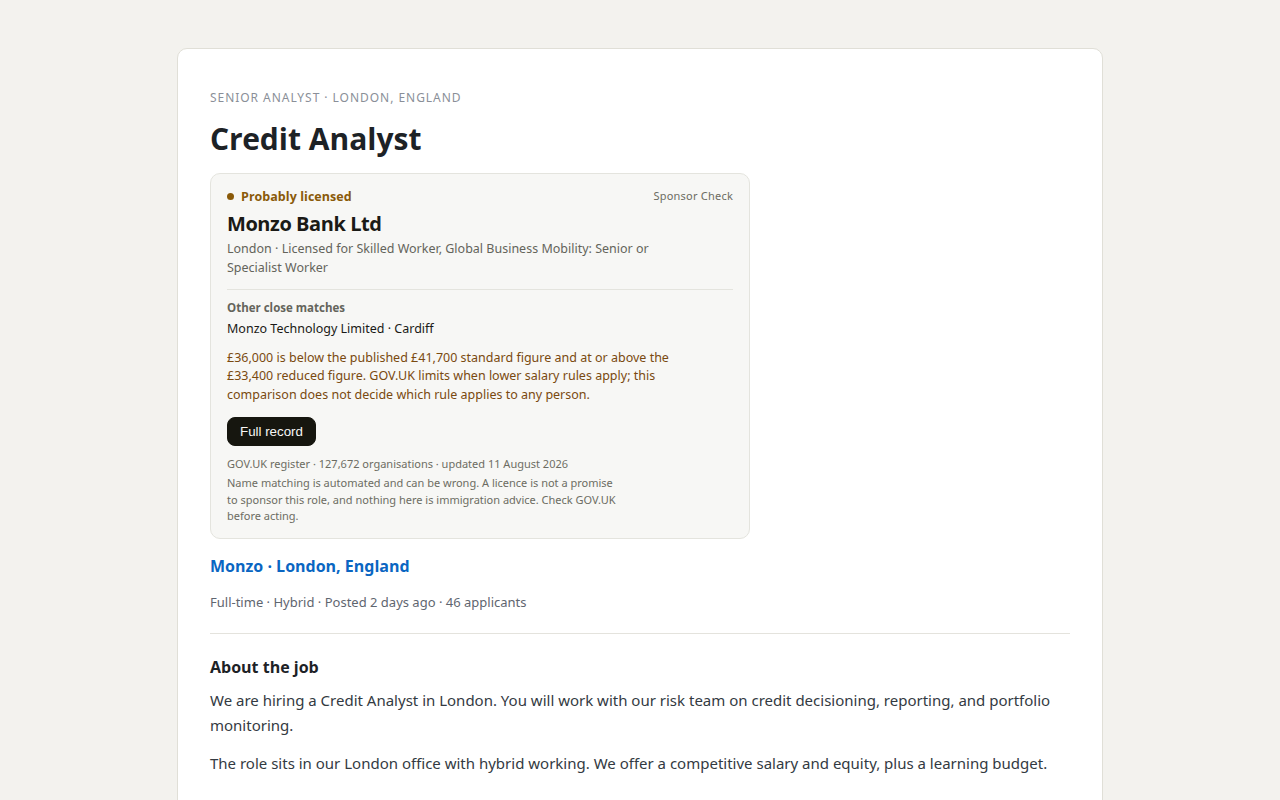
Our product. Sponsor Check is the browser extension sold by THINKINGAI LIMITED, the company identified in this site's footer. The register itself remains free, official, and public. This site is information only, not immigration advice.