Timing a UK Job Search Around Sponsorship
When to start a UK job search, how UK hiring windows work, and the published certificate-of-sponsorship deadlines that decide how early a start date can be.
Quick answer
Work backwards from the start date you need. Two published rules set the outer edges: a worker must apply within three months of a certificate of sponsorship being assigned, and cannot apply more than three months before the job's start date. Between those, the employer's own steps have their own clocks — a defined certificate is usually approved within one working day, while extra undefined certificates usually take 12 weeks, or five working days if expedited. Add UK hiring seasonality on top: graduate schemes open in early autumn, the market slows in late December, and public-sector recruitment follows budget cycles. Start applying earlier than feels natural, and check the register again before every step that costs you real time.
Key takeaways
- Certificate timing rules are published and precise. Employer internal timing
is neither.
- A certificate assigned too early expires; assigned too late, it delays the
start.
- Graduate schemes in the UK often close months before they start.
- December to early January is the quietest stretch in most sectors.
- Undefined certificate allocations can be the hidden delay in an otherwise fast
process.
- Rules that expire have planning consequences: the Temporary Shortage List and
expanded Immigration Salary List run to 31 December 2026.
- A sponsor licence is permission to sponsor, not a promise to sponsor any role
or any person, and no amount of good timing changes that.
Start from the date, not from today
Most job searches are planned forwards: "I'll start applying now and see what happens." For a sponsored role that produces a predictable failure — applications land at the wrong point in an employer's cycle, and the offer arrives with a start date the certificate rules cannot accommodate.
Plan backwards instead. Write down the date you need to be working, then place the fixed steps behind it:
| Step | Whose clock | What is published |
|---|---|---|
| Start date | Employer | Set in the offer |
| Visa decision | UKVI | Indicative processing times are published on GOV.UK |
| Application submitted | You | Within 3 months of certificate assignment; no earlier than 3 months before the start date |
| Certificate assigned | Employer | Defined: usually 1 working day. Undefined extra requests: usually 12 weeks, or 5 working days expedited |
| Offer and contract | Employer | No published timing |
| Interview process | Employer | No published timing |
| Application | You | This is the only step you fully control |
The certificate figures come from GOV.UK's certificates of sponsorship page and were verified on 6 August 2026 Source: GOV.UK — Certificates of sponsorship. Processing times for the visa application itself change, so check the current position on GOV.UK rather than relying on a figure you read somewhere Source: GOV.UK — Skilled Worker visa.
The two three-month rules, explained properly
These two sentences shape every sponsored start date, and they pull in opposite directions.
Rule one: apply within three months of assignment. Once the employer assigns the certificate, the clock starts. Miss the window and the certificate is spent.
Rule two: do not apply more than three months before the start date. An employer cannot get ahead of the process by assigning a certificate a year in advance and having you apply immediately.
Put together, they create a working window rather than a deadline. If your start date is 1 June, an application made much before 1 March is too early. And once the certificate exists, you have three months to use it.
What this means in practice
- A start date far in the future is not a reason to relax. It is a reason to
know when the window opens.
- An employer that assigns a certificate is committing. The fee is spent and
the clock is running.
- Delays on your side are expensive. Documents you do not have yet are the
usual cause. Gather them while you interview, not after.
Defined versus undefined certificates, and why it can matter
The kind of certificate the employer needs depends on where you are applying from, and the two behave very differently.
| Defined | Undefined | |
|---|---|---|
| Applies to | Skilled Worker applying from outside the UK | Skilled Worker applying inside the UK, and other routes |
| Source | Requested per worker | Drawn from the sponsor's annual allocation |
| Published timing | Usually approved within 1 working day | Extra requests usually 12 weeks, or 5 working days expedited |
If you are switching inside the UK and the employer has used its annual allocation, the wait for extra certificates is measured in weeks. It rarely comes up in interviews because it is an internal matter, but it is the most common invisible cause of a delayed start.
You do not need to raise this as a technical question. "What start date are you working towards, and is there anything on your side that would move it?" gets you the same information without asking an HR team to explain their allocation. Our guide to asking about sponsorship at interview covers phrasing.
UK hiring seasons
Seasonality is not a rule, but it is consistent enough to plan around.
Autumn: the graduate window
UK graduate schemes typically open between late August and October for programmes starting the following summer or autumn. Many close when they fill rather than on the advertised date, so applying in the first weeks matters more than the deadline suggests. Some large schemes run assessment centres from November.
If you are targeting graduate schemes, the practical implication is stark: the application season for a September start happens roughly a year earlier.
January: the reset
Budgets refresh, resignations land after the new year, and vacancy volumes rise through January and February. This is a strong stretch for experienced-hire roles in most sectors.
Spring: steady
March to May is generally the most consistent period for professional hiring. Fewer deadlines, more roles.
Summer: slower decisions
Roles keep appearing, but decision-makers take leave and processes stretch. An offer that would take three weeks in March can take six in August.
Late December: quiet
Between mid-December and early January, most processes pause. Use it to prepare rather than to expect replies.
Public sector and academia
NHS trusts, universities and councils run to budget and academic cycles, with recruitment clustered accordingly. Academic roles in particular follow the academic year rather than the calendar year, and notice periods in the sector tend to be longer.
A realistic backwards plan
Here is a plan built backwards from a target start, using only the published certificate rules and generous allowances for the steps that have no published timing.
The durations for interview and offer stages below are planning assumptions, not published figures.
| Working back from the start date | Step |
|---|---|
| Start date | Begin work |
| Before that | Visa decision — check GOV.UK for current indicative times |
| Before that | Application submitted, inside the three-month windows |
| Before that | Certificate assigned |
| 2–6 weeks before that | Offer, contract, internal approvals |
| 4–10 weeks before that | Interview process |
| 1–4 weeks before that | Application acknowledged and screened |
| Add 4–8 weeks | Building the shortlist and applying |
Add a notice period if you are already employed. For most people this lands between four and eight months before the desired start date, which is considerably earlier than instinct suggests.
What to do in each phase
Phase one: shortlist (weeks one to two)
Build a list of employers rather than a list of adverts. Start from the official Register of Licensed Sponsors: Workers, which lists organisations permitted to sponsor, with their town, county, licence rating and routes Source: GOV.UK — Register of licensed sponsors: workers. Our copy of the file, published as of 11 August 2026, holds 127,672 organisations. Note the date of the file you searched.
Our guide to finding UK jobs that sponsor visas covers the method.
Phase two: apply on a rhythm (weeks two to ten)
A weekly slot beats sporadic bursts. Check your shortlist's career pages, read each new advert in a fixed order, apply to the ones that survive, and log everything with dates. Our guide to reading a UK job ad sets out the read order, and our guide to searching company career pages covers where to look.
Phase three: process (weeks six to sixteen)
Once you are in processes, two things matter: keep applying, and gather documents. Passport validity, qualification certificates, references, employment evidence, and anything an application will need. Chasing a document after a certificate is assigned is how the three-month window gets wasted.
Phase four: offer and certificate
This is the employer's phase. Your job is to be responsive and to keep your paperwork ready. Re-check the employer's register entry before you resign from anything — ratings do change, and a B-rated sponsor cannot assign new certificates until it returns to an A rating.
Rules with expiry dates
Timing is not only about your calendar. Some rules have their own.
The Temporary Shortage List and the expanded Immigration Salary List are set to end on 31 December 2026, and the Migration Advisory Committee's final recommendations were due in July 2026 Source: GOV.UK — Temporary Shortage List: Stage 1 report. Verified against GOV.UK on 6 August 2026.
If your plan depends on either list, that date belongs in your planning document. Not as a prediction — nobody can tell you what follows it — but as a prompt to check GOV.UK again before you commit.
Things that waste months
Waiting for a perfect role. A shortlist of sixty employers checked weekly produces a steady flow. Waiting for the ideal advert produces nothing for weeks and then panic.
Applying without checking the licence. Every application to an unlicensed employer for a role you need sponsored is an evening you do not get back. Check first.
Not logging rejections. Six weeks later you re-read the same advert, decide it looks promising, and discover you already applied.
Treating silence as a decision. UK employers frequently take three to four weeks to respond at the screening stage, and longer in August and December.
Assuming a January start is easy. December is the quietest decision-making month of the year.
When two processes run at different speeds
Sooner or later you will have one employer at final stage and another that has just invited you to a first interview. The temptation is to stall the fast one. It rarely works, and it costs goodwill at the employer that is actually moving.
What does work is being specific about dates rather than about preferences.
- Ask the slower process for its timeline in one message: "Could you tell me the
expected timeline for the remaining stages?" A concrete answer lets you decide; a vague one is also an answer.
- Tell the faster process the truth about your constraint, once, without naming
the other employer. "I'd want to give you a decision by the 14th" is reasonable and normal.
- Do not ask a sponsored offer to wait long. Once a certificate is assigned, the
three-month application window is running, and the employer has paid a fee against a start date they need.
The specific risk with sponsored offers
An unsponsored offer can usually be held open informally for a week. A sponsored one carries published deadlines and a real cost the employer has committed. If you delay, you are not just testing their patience — you are consuming a window the rules set.
If you genuinely cannot decide by the date they need, say so plainly and let them choose. That is a better outcome than a certificate assigned to someone who then withdraws.
Withdrawing well
If you take another role, withdraw from the others the same day and say so directly. UK sectors are smaller than they look, and the recruiter you withdraw from politely this year is often the one screening you next year.
The bottom line
Sponsored job searches fail on timing more often than on merit. Fix the two published deadlines in your plan — apply within three months of assignment, and no earlier than three months before the start date — then add the employer's own certificate step, the seasonality of UK hiring, and the weeks that shortlisting and interviewing actually take. The honest total is longer than it feels, which is why starting earlier is the one decision that consistently helps.
And keep re-checking the source. The register file changes almost daily, and a licence is permission to sponsor, not a promise to sponsor any role or any person.
This page is information, not immigration advice. This site is not affiliated with the Home Office or GOV.UK. Rules and processing times change; check the GOV.UK pages linked below, and speak to an adviser registered with the Immigration Advice Authority or a regulated solicitor about your own circumstances.
Frequently asked questions
How far in advance should I start a UK job search?
Working backwards from a target start date, most people need four to eight months, including shortlisting, applications, the interview process, the employer's certificate step, and the visa application.
How long is a certificate of sponsorship valid?
The worker must apply within three months of the certificate being assigned, and cannot apply more than three months before the job's start date.
How quickly can an employer assign a certificate?
A defined certificate, used when applying from outside the UK, is usually approved within one working day. Undefined certificates come from the sponsor's annual allocation, and extra requests usually take 12 weeks, or five working days if expedited.
How long does a Skilled Worker visa decision take?
UKVI publishes indicative processing times on the GOV.UK Skilled Worker pages. They change, so check the current figures there rather than relying on a number from a third-party site.
When do UK graduate schemes open?
Typically between late August and October, for programmes starting the following year. Many close once filled, so early applications matter more than the stated deadline.
What is the quietest time in the UK job market?
Mid-December to early January, when most decision processes pause. August is also slower because of annual leave.
When is the busiest hiring period?
January and February see a rise in vacancies as budgets refresh, and March to May tends to be the most consistent stretch for professional hiring.
Can I apply for a visa before I have a job offer?
The Skilled Worker route requires a certificate of sponsorship from a licensed sponsor, which follows an offer. Other routes have different requirements — which of them might apply to you is a question for a regulated adviser.
Should I tell an employer I have a deadline?
If you have a genuine constraint, saying so once and factually is reasonable. Employers plan start dates all the time, and a clear constraint is easier to work with than a vague one.
What if the employer's rating changes during my process?
A B-rated sponsor cannot assign new certificates until it returns to an A rating. Re-check the register before any step that costs you significant time.
Do notice periods affect sponsorship timing?
They affect your start date, which affects when the application window opens, because an application cannot be made more than three months before the start date.
Does applying earlier in the season help?
For schemes that close when filled, applying early means applying while places remain. For rolling experienced-hire vacancies it matters less than matching the advert well.
What should I be doing while waiting for responses?
Gathering documents and continuing to apply. Both remove weeks from the back end of the process, and neither depends on anyone replying to you.
How often should I re-check an employer on the register?
When it joins your shortlist, and again before any step that costs you real time. The register file updates almost daily.
Last reviewed 2026-08-08 by Visa Ready UK Editorial Team. Figures on this page are checked against GOV.UK on the review date. Rules, fees, and salary floors change — always confirm against GOV.UK before you act. Spotted an error?
Check the employer without leaving the job advert
- See the legal sponsor name, town, routes, rating, and close matches on the page.
- Your checks and job-page text stay on your computer; the extension makes no network requests.
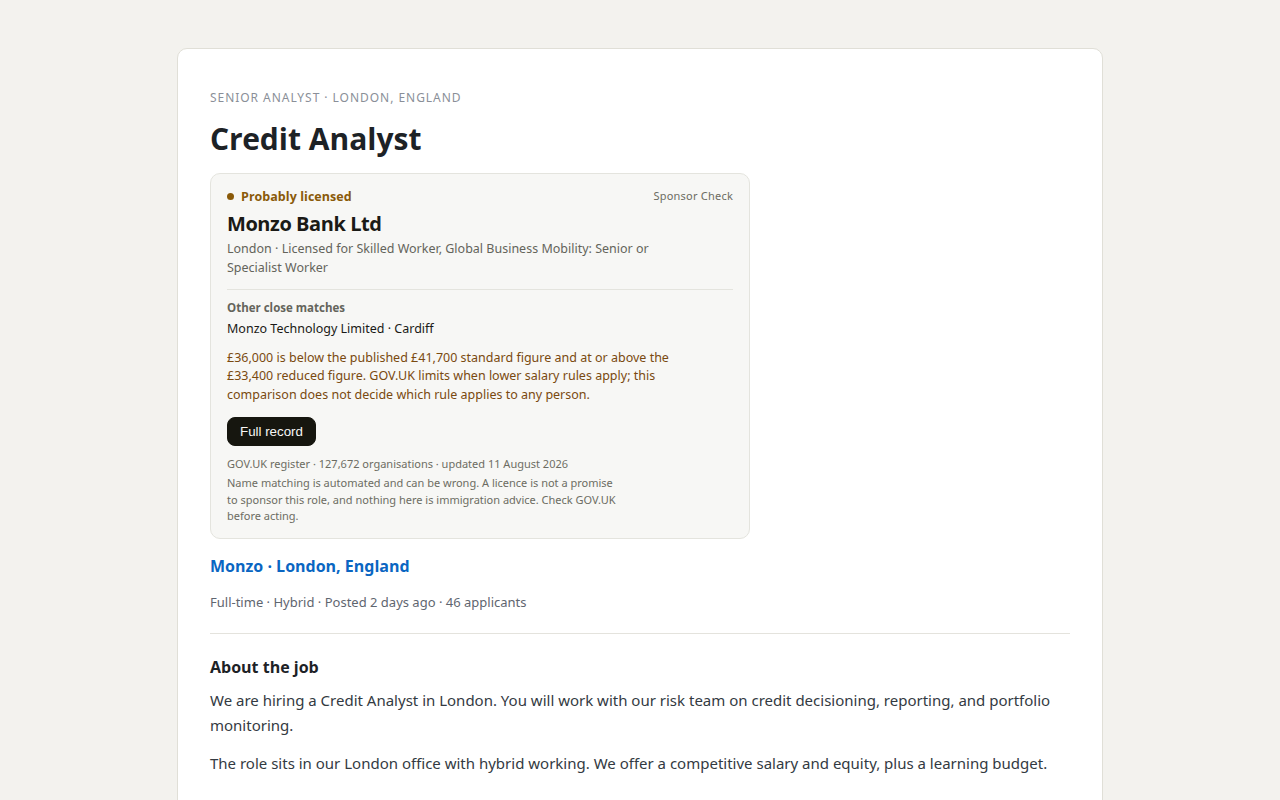
Our product. Sponsor Check is the browser extension sold by THINKINGAI LIMITED, the company identified in this site's footer. The register itself remains free, official, and public. This site is information only, not immigration advice.