How to Find UK Jobs That Sponsor Visas: A 2026 Step-by-Step Guide
A step-by-step 2026 guide to finding UK jobs that can sponsor visas: build a shortlist from the sponsor register, then check every ad.
Quick answer
To find UK jobs that can be sponsored, stop searching keywords and start searching employers. Build a shortlist from the GOV.UK register of licensed sponsors, find those employers' open roles, then check each ad for salary, sponsorship wording, and agency signs before applying. A licence means the employer is permitted to sponsor — it is your entry signal, not a guarantee for any single role.
Key takeaways
- Search employers first: more than 125,000 organisations hold a sponsor
licence (127,672 on the register as of 11 August 2026).
- Job boards mix sponsored and non-sponsored roles; the register separates
them for you.
- Check the legal name, not the ad's brand name, when matching.
- Read every ad for salary and sponsorship wording before applying.
- Track what you learn: application tracking turns a job search into a
repeatable process.
Why "find a sponsored job" is the wrong search
The keyword trap
Searching "sponsored jobs UK" returns ads that use those words — not necessarily jobs that can be sponsored. Employers rarely write "we sponsor visas" in the title. The signal you want is on the employer side: does this organisation hold a sponsor licence?
That is a public, checkable fact. The GOV.UK register of licensed sponsors lists every organisation permitted to sponsor on Worker and Temporary Worker routes Source: GOV.UK — Register of licensed sponsors: workers. The register itself lists 127,672 organisations.
The numbers behind the trap
Work visa grants fell to 168,471 in the year ending December 2025 — 19% below the prior year Source: GOV.UK — Immigration system statistics. When sponsored roles are scarcer, the employers matter more. Searching by employer, not by keyword, is how you spend your applications where they can actually land.
Step 1: Build your sponsor shortlist
Where to start
Use the register or a register search tool to build a list of employers that hold a licence and operate in your field. Free register search sites filter the register by route, sector, location, and rating.
How to shape the list
- List your top sectors (tech, healthcare, engineering, finance, education).
- Filter for the route you would use (usually Skilled Worker).
- Filter by the cities you would live in.
- Keep employers with A ratings first; note B-rated ones separately.
- Aim for 30–60 employers, not 500.
Why the list beats the feed
A shortlist changes your behaviour. Instead of reacting to whatever the job board serves, you check each shortlisted employer's careers page on a schedule. You also develop a repeatable list to re-run when roles open.
A worked example: building the shortlist
The company names below are invented for illustration.
Say you are a data analyst targeting Leeds. Your sector list is tech, finance, and healthcare.
You open the register search, filter to the Skilled Worker route and Leeds, and scan the results. You keep employers with A ratings whose names match your sectors: a bank, a health-tech firm, an engineering consultancy, a university. You put two B-rated employers on a separate watchlist — not discarded, just flagged.
You end with 38 employers. Next step: set a Friday ritual. Every Friday you open the careers pages of ten of them, note new roles, and add them to your tracker. Six weeks later you have seen roughly 200 roles from 38 licensed employers — without a single "sponsorship jobs" search.
That is the whole strategy: register, shortlist, schedule, track.
Step 2: Find their open roles
Job boards still matter
LinkedIn, Indeed, Reed, Totaljobs, Glassdoor, and CV-Library all carry roles from licensed employers. The trick is to search within your shortlist: search the employer name, or set alerts for those employers, rather than searching "sponsorship".
Company career pages matter more
Many roles are only posted on employer career pages built on applicant tracking systems (ATS): Greenhouse, Lever, Ashby, Workday, SmartRecruiters, Teamtailor, Workable, Recruitee, and Pinpoint. Check each shortlisted employer's careers page directly. You will see roles that never reach the big boards, and you will see them before the crowd.
Keep a list of where you looked
Tracking which employers you checked, when, and what you found is a high-leverage habit in a job search. A simple spreadsheet with employer, date checked, roles seen, and notes is enough. Some checker extensions keep this record for you on your device.
How to read a careers page for sponsorship clues
Employer careers pages signal sponsorship in quieter ways than job ads:
- A "work with us" or "relocating to the UK" section usually explains their
sponsorship policy.
- ATS job listings (Greenhouse, Lever, Ashby, Workday, and similar) often
include a sponsorship question in the application form.
- "Visa sponsorship" appears as a filter on some ATS pages.
- Careers pages for NHS trusts, universities, and large consultancies often
state their sponsorship approach outright.
Skim those pages before you apply. They answer questions you would otherwise discover in week three of the process.
Step 3: Check the employer on the ad
The match problem
Job ads show brand names; the register shows legal names. "Barclays" is not "Barclays Bank UK PLC". When you check an employer:
- Match on the legal name, not the ad name.
- If nothing matches, try a shorter or longer version of the name.
- If a checker offers close matches, read them before deciding.
Tools that do it on the page
Checker extensions read the employer name on the job page you already have open and match it against the register. Good ones answer three ways: licensed sponsor, probably licensed (with candidates listed), or not on the register. The GOV.UK register itself is free and needs no account; checker extensions may offer a limited trial and charge for unlimited automatic checks Source: GOV.UK — Register of licensed sponsors: workers.
Step 4: Read the ad before you apply
The three checks
- Salary. The Skilled Worker standard floor is £41,700; the reduced
floor for new entrants is £33,400 Source: GOV.UK — Skilled Worker visa: your job. An ad below the floor is a signal, even from a licensed employer.
- Wording. Ads that say "we cannot sponsor" or "must have the right to
work" rule sponsorship out for that role. Silent ads are not a no. Our guide to sponsorship wording in job ads explains the phrases.
- Advertiser. If a recruitment agency posted the ad, the licence check
applies to the end employer, not the agency. An agency's licence tells you nothing about who you would actually work for. See our guide to agencies versus direct employers.
What the data says about ads
Fewer than four in ten UK ads include salary information — 39% on applicant tracking systems, 37% on LinkedIn, and 27% for agency ads Source: We Show the Salary research via IOP Publishing, 2025. Silence is common. Treat it as a reason to ask, not a reason to assume.
Step 5: Apply, and track what happens
Apply with a target in mind
Applications have two outcomes that matter: interviews and information. Every application you send to a licensed employer teaches you something about that employer's process. Log it.
The tracking habit
For each application, record:
- Employer and role.
- Date applied and where you found it.
- Salary as advertised.
- Whether the employer replied.
- What you learned for next time.
This turns a job search from a lottery into a process you can improve. A 61% share of UK professionals said they planned to look for a new job in 2025, and 54% of job seekers said the process had become harder Source: LinkedIn research reported by Employer News, 2025. The people who win are usually the ones who track and iterate.
What to do when you get an interview
The interview is when sponsorship becomes a conversation, not a question. Raise it after the role itself has been discussed:
- Ask whether the role has been confirmed as sponsorable.
- Ask which entity would assign the certificate of sponsorship.
- Ask about timeline — sponsorship adds weeks to a start date.
- Ask whether the salary as offered meets the route requirements.
Ask calmly and specifically. Employers respect candidates who understand the process; they do not respect pressure. If the answer is unclear, follow up in writing after the interview.
Regional and remote strategies
Why region matters
The register is national, but hiring is regional. London and the South East carry the largest share of professional roles; Manchester, Birmingham, Leeds, and Edinburgh have strong clusters in finance, tech, and engineering. A shortlist built on one region narrows the market to roles you would actually take.
Remote and hybrid roles
Many roles advertise as remote or hybrid. For sponsorship, ask two questions:
- Which entity is the employer? (A remote role at a UK-registered employer
is sponsorable in principle; a role routed through an overseas entity is a different question.)
- Where is the role legally based? Sponsor duties attach to the employing
entity, not the location you work from.
The regional data signal
Only 3.8% of UK job searches on Indeed came from abroad in early 2025 Source: Indeed Hiring Lab, 2025. Most applicants are already in the UK. Being willing to relocate within the UK — and saying so early — genuinely widens your options at licensed employers outside the biggest cities.
Seasonality and timing
When roles open
Graduate and entry-level hiring peaks in autumn and spring. Professional roles follow budget cycles: January–March and September–October are the busiest hiring windows for most employers. Sponsored processes take longer, so a role advertised in spring may still be in process in summer.
What to do between peaks
Between hiring windows, the register still updates weekly. Use the quiet months to rebuild your shortlist, refresh it against the register, and pre-apply: many employers run talent pipelines that open before the advertising wave.
The timing rule
Do not wait for the "perfect" season. Sponsored hiring is uneven, and employers that need a role filled will run the process whenever the vacancy exists. Apply when the role is right and the employer is licensed — season is a signal, not a gate.
Application quality vs quantity
What the data suggests
UK job seekers report that the process has become harder: 54% of job seekers surveyed by LinkedIn said so in 2025 Source: LinkedIn research reported by Employer News, 2025. When every role gets more applicants, the marginal application matters less and the tailored one matters more.
The five-application week
Instead of fifty rushed applications, run five careful ones:
- Employer verified on the register.
- Salary checked against the route floor.
- CV tailored to the role's actual requirements.
- Cover letter that names the employer and one specific reason you fit.
- Notes logged in your tracker for follow-up.
The follow-up rule
Follow up once, seven to ten days after applying, with a one-line message. One polite follow-up can separate you from most applicants without any risk.
Common mistakes to avoid
- Applying to 200 ads a week without checking a single employer.
- Trusting "sponsorship available" wording in an ad from an unlicensed
employer.
- Confusing an agency's licence with the end employer's licence.
- Ignoring salary because "licensed" felt like enough.
- Giving up after two weeks of silence. Sponsored hiring cycles run slow.
The bottom line
Finding UK jobs that can be sponsored is a research process, not a keyword search. Start with the register, build a shortlist of licensed employers, check their roles, and read each ad for salary, wording, and agency signs. Track everything. Free tools cover the employer check — the GOV.UK file, register search sites, and checker extensions all read the same public register. This guide is information, not immigration advice; for your own case, use GOV.UK or a regulated adviser.
Frequently asked questions
How do I find UK jobs that sponsor visas in 2026?
Build a shortlist from the GOV.UK register of licensed sponsors, then search those employers' open roles on job boards and career pages. Check salary, wording, and agency signs on each ad before applying.
Which job boards have sponsored jobs?
LinkedIn, Indeed, Reed, Totaljobs, Glassdoor, and CV-Library all carry roles from licensed employers. Company career pages on systems like Greenhouse, Lever, and Workday carry many more.
Is it better to apply directly to employers or through agencies?
For sponsorship questions, direct employers are usually clearer. An agency's licence says nothing about the end employer. If you go through an agency, ask which employer the role is for and check that employer's licence.
Do I need a job offer before applying for a Skilled Worker visa?
Yes. The route requires a confirmed job offer from an approved employer before you apply Source: GOV.UK — Skilled Worker visa.
How many applications should I send?
Quality beats volume. Fifty targeted applications to licensed employers beat two hundred blind ones. Track replies and adjust.
What if the employer is licensed but the ad says they cannot sponsor?
Believe the ad for that role. A licence is permission to sponsor; the ad says this role is not sponsored. Move on rather than applying anyway.
Can I use a checker extension for free?
Yes. Some checker extensions include a free allowance, and the GOV.UK register is always free to search directly. Paid plans may unlock unlimited automatic checks or additional workflow features.
How often should I re-check a shortlisted employer?
At least monthly, and again right before applying. Licences are granted, suspended, and revoked on a rolling basis. A register entry from three months ago may be stale.
Are smaller employers worth including on the shortlist?
Yes. Small firms sponsor proportionally more in some sectors and move faster than big ones. Their careers pages are simpler and their sponsorship decisions are often made by one person — ask directly.
What if my sector barely appears on the register?
Widen the route filters before you widen the geography. Health and care roles, for example, may sit on the Health and Care Worker route rather than Skilled Worker. Read the route field on each entry.
Should I apply for roles outside my city?
Yes, if you are willing to relocate. Say so in the application. Employers outside London and the South East see far fewer applicants for the same role quality, and some sponsor relocation.
How long does a sponsored hiring process take?
Longer than a standard one. Between the offer, the certificate of sponsorship, and the visa decision, expect several weeks more than a domestic hire. Factor that into your notice period conversations, not your decision to apply.
Should I tailor my CV to every role?
For your five targeted applications, yes. Match the language of the job description where your experience genuinely supports it. Do not fabricate keywords you cannot defend in an interview.
What if I have no reply after two weeks?
Send one short follow-up, then move on. The register tells you the employer can sponsor; it does not tell you when they will reply. Keep the employer on your watchlist and apply to their next relevant role.
What is a certificate of sponsorship?
It is the reference a licensed employer assigns to support a specific visa application. Only the licensed employer can assign one, and only for a genuine eligible role Source: GOV.UK — Sponsor a Skilled Worker.
Can I apply to an employer before they advertise a role?
Yes, and it works more often than expected. A short message to a licensed employer expressing interest, with your CV attached, costs nothing. Many roles are filled before the ad goes live.
How do I know if my role is eligible for sponsorship?
Eligibility has three parts: the occupation must be eligible for the route, the salary must meet the floors, and the employer must hold the licence. The register answers the third; GOV.UK answers the first two.
Last reviewed 2026-08-06 by Visa Ready UK Editorial Team. Figures on this page are checked against GOV.UK on the review date. Rules, fees, and salary floors change — always confirm against GOV.UK before you act. Spotted an error?
Check the employer without leaving the job advert
- See the legal sponsor name, town, routes, rating, and close matches on the page.
- Your checks and job-page text stay on your computer; the extension makes no network requests.
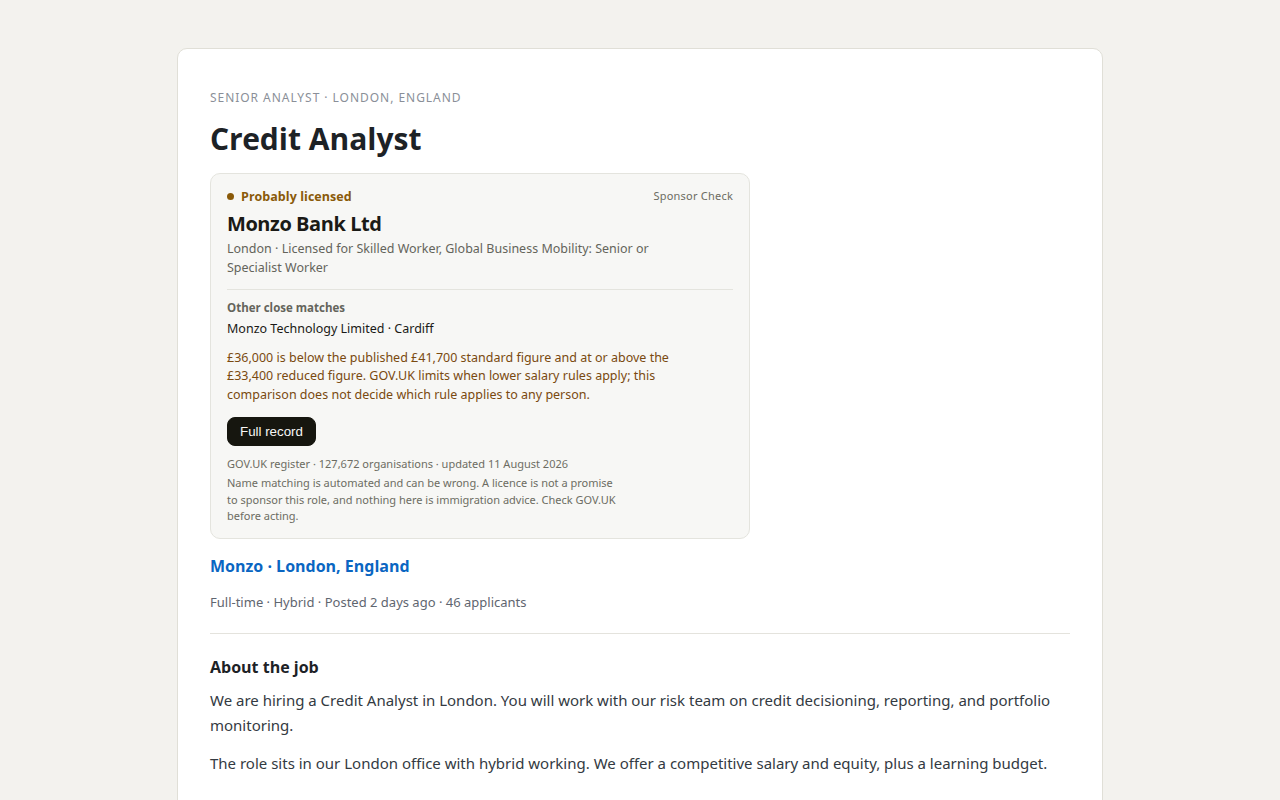
Our product. Sponsor Check is the browser extension sold by THINKINGAI LIMITED, the company identified in this site's footer. The register itself remains free, official, and public. This site is information only, not immigration advice.