Recruitment Agency vs Direct Employer: How to Tell
How to spot recruitment agency job ads, why an agency's licence says nothing about the end employer, and who you'd actually work for.
Quick answer
Roughly one in five job ads on LinkedIn is posted by a recruitment agency, not the employer. That matters for sponsorship because an agency's licence is irrelevant: the licence you need to check belongs to the employer you would actually work for. Ask every agency for the end employer's name, check that employer on the register of licensed sponsors, and treat agency wording as a prompt to verify, never as a green light.
Key takeaways
- Around 1 in 5 LinkedIn job ads come from recruitment agencies.
- An agency's sponsor licence says nothing about the end employer.
- Agency ads share tell-tale signs: vague locations, template wording, and
"our client" language.
- The end employer's name is a normal question to ask before you apply.
- Check the end employer on the register, not the agency.
Why the advertiser matters
The sponsorship trap
Imagine this: you find a great role, apply through an agency, and the agency tells you they can sponsor you. Then you learn the agency holds a licence but the employer you would actually work for does not. The agency's licence was true and useless at the same time.
Sponsorship follows the employer. The certificate of sponsorship (CoS) that supports a Skilled Worker application is assigned by the licensed sponsor for the role. If the end employer is not licensed, no agency wording changes that Source: GOV.UK — Sponsor a Skilled Worker.
How common agency ads are
Agencies post a meaningful share of the UK job market. Research from the We Show the Salary campaign found recruitment agencies account for about a fifth of job adverts on LinkedIn — and their ads are less transparent: only 27% include salary, versus 39% of ads on applicant tracking systems and 37% on LinkedIn overall Source: We Show the Salary research via IOP Publishing, 2025.
How to spot an agency ad
The tell-tale signs
| Sign | Example |
|---|---|
| "Our client" language | "Our client, a global consultancy, is hiring…" |
| No company name | "A fast-growing fintech in London…" |
| Vague location | "Hybrid, UK" or "London / remote" |
| Template phrasing | The same four paragraphs across many roles |
| Salary as a range | "£55k–£75k depending on experience" |
| Multiple roles listed | One ad, five job titles, one contact |
No single sign is proof. Agencies also post clear, named ads. But if you see three or more signs, ask who the employer is before you invest time.
The one question that fixes everything
Before applying, ask: "Which employer is this role with?" A reputable agency answers immediately. An agency that refuses or dodges is telling you something useful.
Why agencies use vague wording
The business reason
Recruiters often advertise roles before the employer has signed off on the job spec, or they run multiple searches for similar roles at once. Vagueness is not malice; it is workflow. But it has a cost for you: you cannot check the one fact that matters — the end employer's licence.
The wording to watch
Sponsorship-related wording from agencies is the least reliable of all, because the agency is not the sponsor. "Sponsorship available" from an agency means "we think the employer may consider it". "No sponsorship" from an agency is usually accurate for the role as advertised, but the employer may disagree.
The wording, ranked by reliability
| Agency phrase | What it means | Trust level |
|---|---|---|
| "We are the employer" | The agency is hiring for itself | Check the agency's licence |
| "Our client requires…" | Someone else is the employer | Low — ask for the name |
| "Sponsorship available" | Someone believes the role may be sponsorable | Verify with the employer |
| "No sponsorship" | The role as advertised is not sponsored | Usually accurate |
| "Must have right to work" | Same as "no sponsorship", softer | Usually accurate |
The pattern to remember: the more the agency says, the less it commits. Names, not claims, are what you need.
A worked example: the agency double-check
The company names below are invented for illustration.
You see an ad on LinkedIn: "Senior Data Analyst — our client, a global consultancy, London hybrid, £60k–£75k, sponsorship considered." The agency is named; the employer is not.
Step one: ask the agency which employer the role is with. The reply comes back: "Northgate Analytics."
Step two: check Northgate Analytics on the register. The legal name comes back as "Northgate Analytics Ltd" — A rating, Skilled Worker route, London. Good sign.
Step three: check the salary. The advertised range clears the £41,700 standard floor. Also good.
Step four: ask the agency to confirm in writing that Northgate will assign a certificate of sponsorship for this specific role. The agency's "sponsorship considered" note is not the employer's commitment. Only the employer can make that commitment.
That is the whole double-check: name, licence, salary, written confirmation. It takes ten minutes and it turns an agency ad into a direct-employer decision.
What to ask an agency: the script
Before applying
- "Which employer is this role with?"
- "Does that employer hold a UK sponsor licence?"
- "Has sponsorship been confirmed for this role, or is it under review?"
After an interview
- "Who would my line manager report to at the end employer?"
- "Will the offer letter come from the employer or the agency?"
- "If sponsorship is needed, which entity assigns the certificate of
sponsorship?"
Get answers in writing. Agencies move fast and memory fades; email does not.
The red flags
- The agency will not name the employer.
- The agency says sponsorship is "definitely fine" but will not put the
employer's name in writing.
- The agency asks you to pay a fee. Legitimate recruiters do not charge
candidates in the UK.
- The ad's salary range is far above the market for the role.
How agencies get paid — and what that tells you
The fee model
Most UK recruitment agencies are paid by the employer, usually a percentage of the hired candidate's salary once the person starts. That model explains the behaviour you see in ads:
- Agencies advertise widely because volume feeds their pipeline.
- They present roles optimistically because a hire pays them.
- They protect employer names until late in the process because they are
competing with other agencies for the same mandate.
None of that is dishonest by itself. But it means the agency's incentives are not yours. Your incentive is to know who the employer is and whether that employer can sponsor. The agency's incentive is to place a candidate. Those overlap only some of the time.
What the fee model means for sponsorship
An agency earns its fee when you start. Sponsorship adds weeks and paperwork to that start — so an agency has an incentive to sound confident about sponsorship before the employer has committed. That is why written confirmation from the employer matters more than the agency's assurances.
The honest agency
Good agencies exist and say so plainly: "The client is licensed, we have confirmed the role can be sponsored, here is the hiring manager's name." When you meet that level of clarity, the process is easy. Treat vagueness as the default and clarity as the exception worth acting on.
The employer questions for your tracker
What to record for every agency role
When an agency is in the chain, your tracker needs four fields the ad does not give you:
- The end employer's name.
- Their register status (licence, rating, routes).
- What the agency said about sponsorship, in writing.
- What the employer confirmed, in writing.
Why the two answers differ
The agency's answer and the employer's answer are different facts from different people. The agency is selling a placement; the employer holds the licence. Record both, and treat the employer's confirmation as the one that counts.
The re-check rule
Re-check the end employer on the register when the offer arrives, not just when you apply. Licences move; the register entry you saw in week one may not be the entry in week eight. A thirty-second lookup before you resign from anything is cheap insurance.
Agency licences: what they actually cover
The licence follows the employer
Agencies can hold sponsor licences too. A staffing company can sponsor a candidate to work at the agency itself — as its own employee. That is a different situation from placing you with a client.
When the work is for a client:
- The client must be the sponsor for the role you do for them.
- The agency's licence does not extend to client roles.
- A client can still decline sponsorship even if the agency is licensed.
This is why the check is always: who is the end employer, and does that entity hold the licence Source: GOV.UK — Sponsor a Skilled Worker?
Temporary worker routes change the picture
Some short-term routes (for example, Seasonal Worker or Temporary Worker routes) work differently, and some are organised through approved operators rather than direct employers. If the role is clearly temporary, check the route on GOV.UK before applying. The register entry will show the route the licence covers, so read that field too.
Direct applications: the clearer path
How to check the real employer
A five-step method
- Ask the agency for the end employer's name, in writing.
- Match that name against the register of licensed sponsors
Source: GOV.UK — Register of licensed sponsors: workers.
- If the register shows nothing, try the legal name — ads often use brand
names.
- Check the advertised salary against the route floors.
- Record the employer name in your tracker so you can check again later.
Tools that help
Some checker extensions flag recruitment agency ads, so an agency posting does not read as a confirmed sponsor. The underlying GOV.UK register is free; extension trial limits vary. A good checker shows you the close matches instead of guessing when it is unsure Source: GOV.UK — Register of licensed sponsors: workers.
Direct applications: the clearer path
Why direct is usually cleaner
Applying directly to a licensed employer removes the middle layer. You ask the employer about sponsorship, and the answer comes from the person who decides. You also avoid the agency's database noise and their incentive to present every role optimistically.
When agencies still make sense
- The agency names the employer and the employer is licensed.
- The role is inside your niche and the agency has a real relationship with
the hiring manager.
- You are using the agency for market information, not as a sponsorship
source.
The rule is the same in both cases: verify the end employer yourself.
How to verify a direct ad
The direct-ad checklist
- Employer name on the ad: copy it exactly.
- Legal name: if the brand name does not match the register, try the legal
name via Companies House.
- Register entry: rating and routes.
- Salary: does it clear the route floor?
- Wording: does the ad rule sponsorship out?
Why direct ads still need the checklist
Direct employers make mistakes too. A hiring manager can paste boilerplate about "right to work" into an ad for a sponsorable role, or advertise a role below the floor because HR never checked. The checklist catches both. Some checker extensions run wording and salary checks on the ad itself, and the free register lookup covers the licence question Source: GOV.UK — Register of licensed sponsors: workers.
The bottom line
The advertiser is not the employer, and the licence that matters is the employer's. Spot the agency signs, ask for the end employer's name, check them on the register, and verify salary before you apply. Agencies can be genuinely helpful — but they are a middle layer, not a sponsorship answer. Free tools can flag agency ads and check the register on the page you are already reading, so the question gets answered before you invest in the application. This guide is information, not immigration advice: route and eligibility questions belong with GOV.UK or a regulated adviser.
Frequently asked questions
How can I tell if a job ad is from a recruitment agency?
Look for "our client", missing company names, vague locations, template language, and salary ranges. No single sign proves it; ask directly if unsure.
Can a recruitment agency sponsor my visa?
An agency can hold a sponsor licence, but its licence covers jobs at the agency, not jobs at its clients. For client roles, the end employer must be the sponsor.
Do I need to check the agency or the employer on the register?
The end employer. The register entry that matters is the one for the company you would work for.
What if an agency will not name the employer?
That is a strong signal. Either the employer has not approved the ad, or the agency is fishing for CVs. Decide whether that is worth your time.
Are agency ads less likely to include salary?
Yes. Research found 27% of agency ads on LinkedIn include salary, versus 39% of ads on applicant tracking systems and 37% on LinkedIn overall.
What should I say when asking about sponsorship through an agency?
Ask two questions in one message: "Which employer is this role with?" and "Can that employer sponsor this role?" Get both answers in writing.
Can an agency charge me for finding a job?
Reputable recruiters in the UK are paid by the employer. If an agency asks a candidate for money, treat it as a red flag and verify the agency before engaging further.
Do temporary worker routes need the end employer to be licensed?
It depends on the route. Some temporary routes are organised through approved operators. Check the route guidance on GOV.UK and read the register entry's route field carefully.
What if the end employer has a B rating?
A B rating means the employer is on a Home Office action plan and generally cannot assign new certificates of sponsorship until it is resolved. Ask the employer directly what that means for this role, and confirm on GOV.UK.
Should I apply to agency ads at all?
Yes, when the employer is named and licensed, or when the role is a strong fit and you can get the employer's name before applying. Apply through agencies the same way you apply direct: verify first.
How do I know an agency is legitimate?
Check that it has a real website, a UK address, and named consultants. Search the agency name plus "reviews". Never pay a fee, and never share passport or bank details with an agency before an offer exists.
What if the employer and agency give different answers on sponsorship?
Trust the employer, in writing. Ask the agency to connect you with the employer's hiring team for confirmation, and record the answer. The licence check on the end employer is the ground truth.
Should I apply directly if I know the employer name?
Usually, yes. If you found the role through an agency, applying direct may break their terms — check the ad or ask. If you found the employer yourself, direct is cleaner: the sponsorship answer comes from the person who decides.
What is the difference between retained and contingent agencies?
A retained agency is paid by the employer to fill a specific role; a contingent agency is paid only if a candidate they introduced is hired. For you, the difference matters less than the same two facts: who is the employer, and does that employer hold the licence?
Should I sign an exclusivity agreement with an agency?
Only if you understand it and it helps you. Exclusivity means you let that agency represent you for certain roles. Before signing, confirm the agency names employers it works with and how it handles sponsorship questions.
Can an agency place me at a licensed employer if the agency has no licence?
Yes. The agency does not need a licence to introduce you; the end employer does. The agency's licence status is irrelevant to your visa route — the employer's is everything.
Last reviewed 2026-08-06 by Visa Ready UK Editorial Team. Figures on this page are checked against GOV.UK on the review date. Rules, fees, and salary floors change — always confirm against GOV.UK before you act. Spotted an error?
Check the employer without leaving the job advert
- See the legal sponsor name, town, routes, rating, and close matches on the page.
- Your checks and job-page text stay on your computer; the extension makes no network requests.
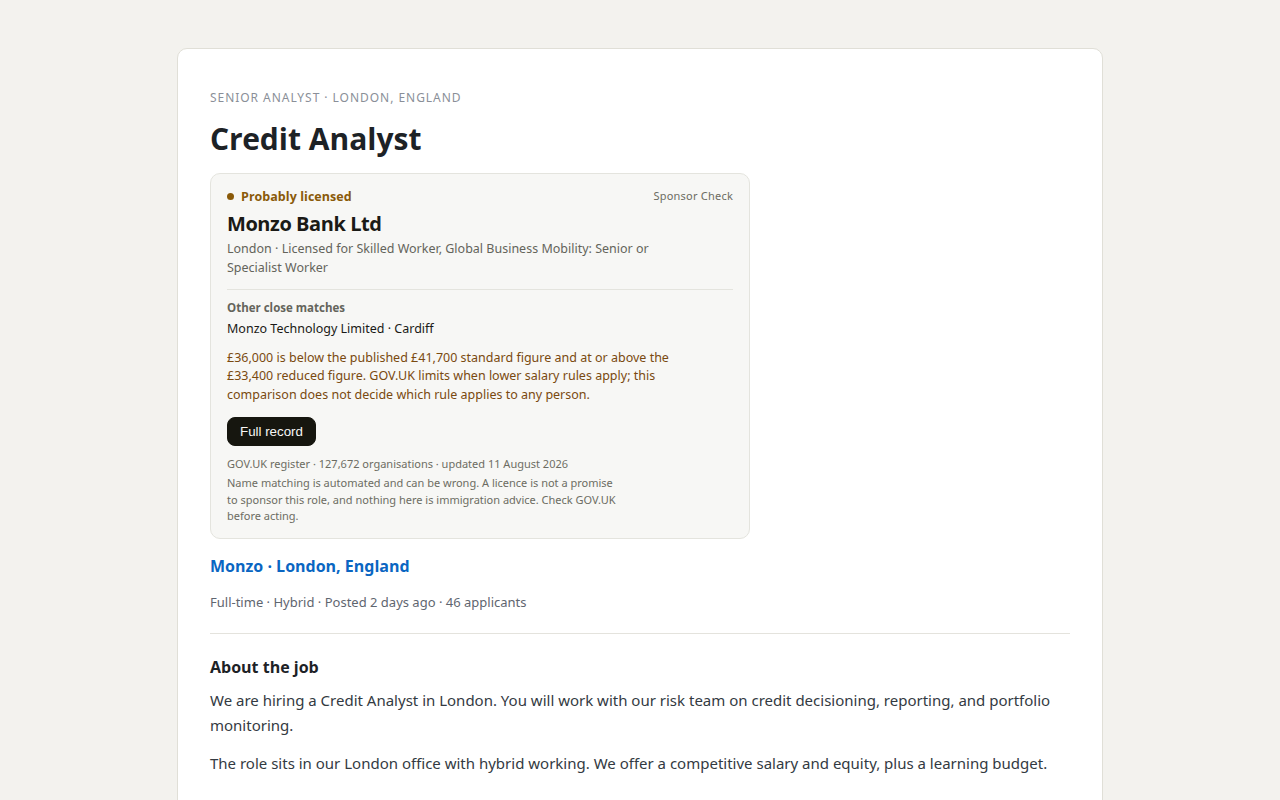
Our product. Sponsor Check is the browser extension sold by THINKINGAI LIMITED, the company identified in this site's footer. The register itself remains free, official, and public. This site is information only, not immigration advice.