How to Read a UK Job Ad When You Need Sponsorship
A six-pass method for reading UK job ads when you need sponsorship: salary, wording, advertiser, location, code, and date, in about ninety seconds.
Quick answer
Read every UK job ad in six passes, in this order: the salary, the sponsorship wording, who is advertising, the location and work pattern, the likely occupation code, and the posting date. The order matters because salary and wording rule out roles faster than anything else, and there is no point researching an employer for a job that cannot clear the salary floor. The whole pass should take about ninety seconds. Roles that survive it go on your shortlist; everything else gets closed without guilt.
Key takeaways
- Salary first. The standard Skilled Worker floor is £41,700 a year or the
going rate for the occupation, whichever is higher.
- A salary range means the bottom of the range, until an employer says
otherwise.
- "No sponsorship available" is a fact. Silence is not.
- Who posted the ad changes what the ad can tell you.
- The occupation code drives the going rate, and the code follows the duties,
not the job title.
- Old ads waste more time than bad ads.
- A sponsor licence is permission to sponsor, not a promise to sponsor any role
or any person.
Why order matters more than thoroughness
Most people read job ads top to bottom, get excited by the responsibilities, and only reach the salary after they have mentally moved to Manchester. Then they apply anyway, because they have already invested.
Reading in a fixed order fixes that. You check the things that disqualify fastest, first. Around half of the ads you open will fail pass one or pass two, which means you spend your real attention on a much smaller, much better set.
The six passes below are ordered by how quickly each one can end the conversation.
Pass one: the salary
The two numbers
Sponsorship salary is always two tests, and an ad only ever shows you one side of them.
| Test | What it is |
|---|---|
| General threshold | £41,700 a year for most Skilled Worker roles |
| Going rate | A per-occupation rate; the role must meet whichever is higher |
Lower floors exist for defined groups: £33,400 for jobs on the immigration salary list, for new entrants under 26, for students and recent graduates, and for STEM PhD holders; £37,500 for non-STEM PhD holders Source: GOV.UK — When you can be paid less. These figures were verified against GOV.UK on 6 August 2026.
How to read a range
An ad saying "£38,000 – £48,000" is telling you the employer expects to pay someone at £38,000. Treat the bottom of the range as the number until an employer tells you otherwise in writing. If the bottom of the range sits below the floor that applies to you, the role only works if you are hired at the top of the band — which is possible, and is a conversation to have early rather than after four interview rounds.
The traps
- "Competitive salary" — no number, no assessment possible. Not
automatically a bad sign, but it moves the salary question to your first conversation.
- Pro-rata and part-time — going rates assume a 37.5-hour week and are
pro-rated for other hours Source: GOV.UK — Going rates for eligible occupation codes. A part-time role at a headline full-time salary is not what it looks like.
- Bonus and equity — the salary test looks at guaranteed basic pay. A
package inflated by a discretionary bonus does not lift the base.
- "Up to" — the same as a range with the bottom hidden.
The ninety-second decision
If the guaranteed base is clearly below the floor that applies to you, and the ad gives no reason to think otherwise, close it. That is not pessimism, it is arithmetic.
Pass two: the sponsorship wording
The three states
Job ads say one of three things, and only two of them are information.
| What the ad says | What it means |
|---|---|
| "We are able to sponsor" / "visa sponsorship available" | A statement of intent. Still verify the licence. |
| "We are unable to offer sponsorship" / "must have existing right to work" | A clear no for this role. Believe it. |
| Nothing at all | Unknown. Most ads say nothing. |
Silence is the normal case, not a hidden yes or a hidden no. Employers who sponsor routinely often do not mention it, because the ad is written for everyone. Employers who never sponsor often do not mention it either.
What "must have the right to work in the UK" means
This phrase appears on a huge share of UK ads and causes more misreading than any other. It is usually a restatement of the employer's legal duty, not a policy statement about sponsorship.
Every UK employer has to check that a person can work here before they start, using an online share code, a manual document check, or an identity service provider Source: GOV.UK — Check a job applicant's right to work. Getting it wrong carries a civil penalty of up to £60,000 per illegal worker, and in serious cases up to five years in prison and an unlimited fine Source: GOV.UK — Penalties for employing illegal workers.
So the sentence can mean "we will check your status" or it can mean "you must already hold status". The ad alone rarely distinguishes them. We take this phrase apart properly in our guide to job ads that rule out sponsorship.
The rule
Treat an explicit no as final. Treat silence as a question for later, not a reason to skip the ad. Do not read hidden meaning into boilerplate.
Pass three: who is advertising
Three kinds of advertiser
| Advertiser | What you can verify | What to watch |
|---|---|---|
| The employer directly | Their legal name, licence, rating, routes | Little — this is the clearest case |
| A recruitment agency | Often nothing, until they name the client | The employer may be undisclosed |
| A job board aggregator | The original source, if you can find it | Reposts, stale listings, altered details |
When an agency advertises, the licence question moves one step away: the agency's own licence status is usually irrelevant, because the sponsoring organisation would be the end employer. Asking "who is the hiring company?" is a reasonable, standard question. Our guide to recruitment agencies versus direct employers covers how to ask it well.
A note on fees
A recruitment agency cannot charge you a fee to find you work. That is a breach of the rules the Fair Work Agency enforces — the FWA began operating on 7 April 2026, replacing the Employment Agency Standards Inspectorate, and enforces the Employment Agencies Act 1973 and the Conduct of Employment Agencies and Employment Businesses Regulations 2003 Source: GOV.UK — Making a complaint about your recruitment agency. Complaining to the FWA is free.
Anyone asking you to pay for a job, a visa, or a certificate of sponsorship is describing something the system does not permit.
Verifying the employer
Once you have a name, check it against the GOV.UK Register of Licensed Sponsors: Workers. Search the legal name, not the brand: "Tesco Stores Limited", not "Tesco". The register held 127,672 organisations in the file published as of 11 August 2026 Source: GOV.UK — Register of licensed sponsors: workers.
Remember what a hit means and does not mean. A licence is permission to sponsor. It is not a promise to sponsor any role or any person.
Pass four: location and work pattern
Where the job actually is
The register lists the sponsor's licence address town. The job can be anywhere. A London-headquartered sponsor can advertise a role in Newcastle, and the register will still say London. Do not use the register to infer where you would work, and do not discount an employer because the town looks wrong.
Remote and hybrid
Remote roles raise a question ads rarely answer: which legal entity employs you, and is that entity the one holding the licence? A UK-advertised remote role at a company whose UK arm is small may be run through an overseas entity. That is a question to ask, not to assume.
Regional strategy
Salary floors are national, but going rates are not adjusted by region, and competition is not evenly spread. Ads outside London and the South East often attract far fewer applicants for the same role. If your occupation's going rate is comfortably clear of the general threshold, widening your geography is usually the single cheapest change you can make to your search.
Pass five: the likely occupation code
Why the code decides so much
Every sponsored role sits under an occupation code, and that code sets the going rate. Codes vary enormously: chief executives at £88,100, electrical engineers at £58,700, chefs at £33,400 under the standard rate. All verified against GOV.UK on 6 August 2026.
The code follows the duties, not the title. "Product Ninja" is not a code. Read the responsibilities section and ask which published occupation those duties actually describe.
The skill level test
Since 22 July 2025 the Skilled Worker skill threshold has sat at RQF level 6, broadly degree level, a change that removed around 180 eligible occupations Source: GOV.UK — Explanatory memorandum to HC 997, 1 July 2025.
A separate temporary shortage list restores eligibility for some RQF 3–5 occupations, but with no salary discount and no dependants, and it is due to end on 31 December 2026 Source: GOV.UK — Temporary shortage list: stage 1 report.
What this looks like in practice
Read the duties. Guess the code. Look up the going rate for that code. Compare it to the advertised salary. If the advertised salary is below the going rate, the role does not work at that pay, no matter how well you fit it.
This is the pass most people skip, and it is the one that explains the most otherwise-baffling rejections.
Pass six: the posting date
Old ads are expensive
A job posted eleven weeks ago on an aggregator may have been filled two months ago. You will still get an auto-acknowledgement. You will still wait. You will still count it as an application.
Look for a date on the original source, not on the aggregator. If you cannot find one, treat it as unknown and lower your expectations accordingly.
Reposts and ghost listings
The same role appearing repeatedly under slightly different titles usually means one of three things: an agency working the same client, a genuinely hard role, or a listing kept live to collect CVs. None of them are reasons to apply three times.
The whole method on one page
| Pass | Question | Fail condition |
|---|---|---|
| 1. Salary | Does guaranteed base clear the floor that applies to me? | Clearly below, no reason to think otherwise |
| 2. Wording | Does it explicitly rule out sponsorship? | Explicit no |
| 3. Advertiser | Do I know who the employer would be? | Unknown and unanswerable |
| 4. Location | Where is the job, and which entity employs me? | Unworkable location or entity |
| 5. Code | Does the salary clear the going rate for the duties? | Below going rate |
| 6. Date | Is this ad current? | Stale with no live source |
Anything that passes all six goes on the shortlist with a dated note: employer legal name, licence status and rating on the day you checked, salary, and the date of the ad. That note is what makes your search reviewable in a month.
A worked example
The employer below is invented for illustration.
The ad. "Senior Data Engineer, Bristol, £42,000 – £52,000. Hybrid, 3 days on site. Applicants must have the right to work in the UK. Posted 4 days ago by Kelbrook Talent Partners."
- Pass 1 — salary. Base starts at £42,000, above the £41,700 general
threshold. Survives, but only just at the bottom of the range, and the going rate still has to be checked.
- Pass 2 — wording. Right-to-work boilerplate, not an explicit no.
Survives.
- Pass 3 — advertiser. An agency. The employer is unnamed, so the licence
cannot be checked yet. Action: ask who the client is.
- Pass 4 — location. Bristol, hybrid three days on site. Workable if you
can be in Bristol. Survives.
- Pass 5 — code. Duties describe a data engineering role. Look up the going
rate for the matching code. If it exceeds £42,000, the bottom of the range does not work and the conversation has to start at the top of the band.
- Pass 6 — date. Four days old, from the agency directly. Fresh. Survives.
Result: apply, and ask two questions in the first reply — who is the hiring company, and where in the band does this role sit. Both are normal questions. Neither is rude.
What this method does not do
It does not tell you whether an employer will sponsor you. Nothing public does. It tells you which roles are possible, so that your effort lands on those instead of on the ones arithmetic already ruled out.
It also does not replace advice on your own immigration position. This page is information, not immigration advice. This site is not affiliated with the Home Office or GOV.UK. For your own circumstances, check GOV.UK or speak to an adviser registered with the Immigration Advice Authority or a regulated solicitor.
The bottom line
Ninety seconds, six passes, in order: salary, wording, advertiser, location, code, date. Most ads fail on the first two, which is the point — the method exists to protect your attention, not to fill a spreadsheet.
What survives gets a dated note and a real application. What does not gets closed. And the one question no ad can answer — will this employer sponsor me — gets asked directly, once, to a human.
Frequently asked questions
How do I know if a UK job offers visa sponsorship?
Most ads do not say. Check whether the employer holds a sponsor licence on the GOV.UK register, read the ad for an explicit refusal, and ask the employer directly if neither answers it. A licence means the employer is permitted to sponsor, not that they will.
What does "must have the right to work in the UK" mean on a job ad?
Usually that the employer will check your status before you start, which every UK employer must do by law. It sometimes means they will not sponsor. The phrase alone does not distinguish the two, so ask.
Is a salary range the same as the salary?
No. Read the bottom of the range as the offer until an employer says otherwise. For sponsorship, only guaranteed basic pay counts towards the salary tests, not bonuses or equity.
What salary do I need for a UK Skilled Worker visa?
Usually £41,700 a year or the going rate for the occupation, whichever is higher. Lower floors of £33,400 or £37,500 apply to defined groups such as new entrants and PhD holders. Verified against GOV.UK on 6 August 2026.
Why do so many ads not mention sponsorship?
Because ads are written for every applicant, not just international ones. Employers who sponsor often and employers who never sponsor both frequently say nothing.
Should I apply if the ad says no sponsorship?
Applying against an explicit no is rarely a good use of a slot. Employers who write it usually mean it, and your time is better spent on ads that have not closed the door.
How do I find out which company an agency is recruiting for?
Ask. It is a standard question and most consultants will answer once you have had a first conversation. Some will not name the client until later in the process, which is normal.
Can a recruitment agency charge me to find work?
No. Charging a work-seeker a fee to find them work is a breach of the rules enforced by the Fair Work Agency, which took over from the Employment Agency Standards Inspectorate on 7 April 2026. Complaining to them is free.
How do I find a job's occupation code?
Match the duties in the ad against the published occupation list on GOV.UK. The code follows what the role does, not what it is called.
Does the sponsor register tell me where the job is?
No. It shows the sponsor's licence address town, which is often not where the job is. Use the ad for location and the register only for licence status.
How old is too old for a job ad?
There is no fixed rule, but ads more than about six weeks old on aggregators are frequently filled. Look for a date on the employer's own careers page before applying.
Do part-time roles work for sponsorship?
Going rates assume a 37.5-hour week and are pro-rated for other hours, so a part-time salary is measured against a pro-rated rate. The general threshold still applies in full, which is why part-time sponsored roles are uncommon.
Should I trust a job ad that promises a visa?
Treat it with caution. No employer or agency can promise a visa outcome, and anyone asking for payment in exchange for one is describing something the system does not permit. Report suspected fraud at reportfraud.police.uk.
What should I record when I shortlist a role?
The employer's legal name, their licence status and rating on the day you checked, the date of that check, the advertised salary, and the date of the ad. Dated notes are what let you review your search sensibly later.
Is remote work eligible for sponsorship?
The question is which legal entity employs you and whether that entity holds the licence. A remote UK role advertised by an international company is worth asking about specifically.
Last reviewed 2026-08-06 by Visa Ready UK Editorial Team. Figures on this page are checked against GOV.UK on the review date. Rules, fees, and salary floors change — always confirm against GOV.UK before you act. Spotted an error?
Check the employer without leaving the job advert
- See the legal sponsor name, town, routes, rating, and close matches on the page.
- Your checks and job-page text stay on your computer; the extension makes no network requests.
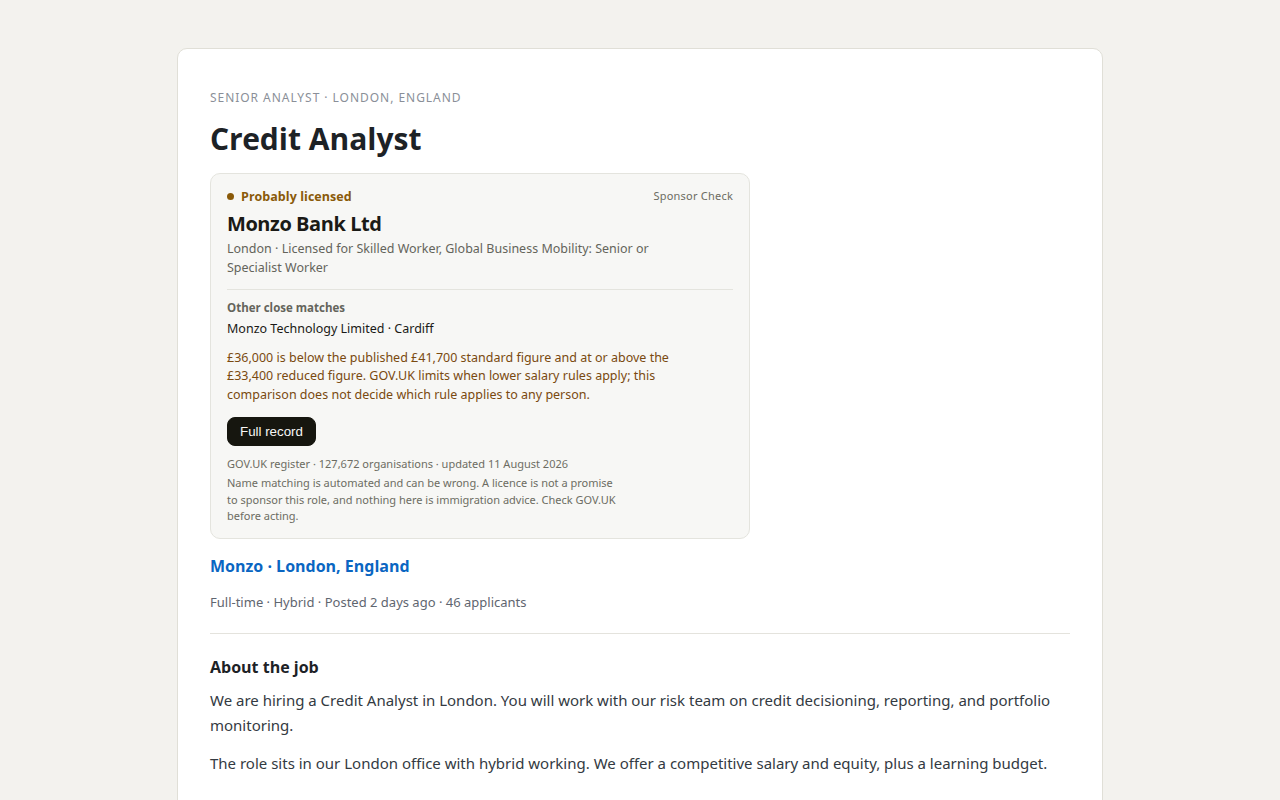
Our product. Sponsor Check is the browser extension sold by THINKINGAI LIMITED, the company identified in this site's footer. The register itself remains free, official, and public. This site is information only, not immigration advice.
Sources
- Skilled Worker visa: when you can be paid less — GOV.UK
- Skilled Worker visa: going rates for eligible occupation codes — GOV.UK
- Check a job applicant's right to work — GOV.UK
- Penalties for employing illegal workers — GOV.UK
- Register of licensed sponsors: workers — GOV.UK
- Making a complaint about your recruitment agency — GOV.UK
- Explanatory memorandum to the statement of changes to the Immigration Rules: HC 997 — GOV.UK
- Temporary shortage list: stage 1 report — GOV.UK
- Find an immigration adviser — GOV.UK