We Cannot Sponsor: What Sponsorship Wording in Job Ads Means
What 'we cannot sponsor', 'must have the right to work', and other sponsorship phrases in UK job ads mean — and how to read the ads that say nothing at all.
Quick answer
When a UK job ad says "we cannot sponsor" or "must have the right to work", it means that specific role is not being sponsored — regardless of whether the employer holds a sponsor licence. That wording saves you time: do not apply for that role expecting sponsorship. Ads that say nothing about sponsorship are different. Silence is not a no. Check the employer's licence and ask directly.
Key takeaways
- Hard phrases like "we cannot sponsor" rule the role out, not the employer.
- Soft phrases like "UK applicants only" are a caution, not a verdict.
- Silent ads are the majority; treat silence as a reason to check, not assume.
- Licence status and ad wording are two separate checks.
- "Cannot sponsor this role" never means "cannot sponsor any role ever".
The phrase book
Hard phrases that rule a role out
Some wording is decisive for the role in question:
- "We are unable to provide visa sponsorship."
- "Applicants must already have the right to work in the UK."
- "Visa sponsorship is not available for this position."
- "No sponsorship will be provided."
When an ad contains wording like this, the employer has decided that this role is not sponsored. The decision is role-specific. The same employer may sponsor other roles.
Soft phrases that need context
Other wording is suggestive but not decisive:
- "UK-based candidates only."
- "We welcome applications from candidates with the right to work."
- "Please note this role does not meet the criteria for sponsorship."
"UK-based" can mean "based in the UK", not "UK citizens only". "With the right to work" is sometimes boilerplate that contradicts a sponsorable role. Read the sentence, not the slogan.
The phrase that changes everything
The most valuable ad wording is positive: "We are able to provide visa sponsorship for this role." When an ad says that, the employer has already decided the role can be sponsored — the check moves to your eligibility, which is a GOV.UK question.
The phrase book, ranked by what it decides
| Wording | Category | What it decides |
|---|---|---|
| "We are unable to provide visa sponsorship" | Hard | This role is not sponsored |
| "Must have the right to work" | Hard | This role is not sponsored (usually) |
| "No sponsorship available for this position" | Hard | This role is not sponsored |
| "UK-based candidates only" | Soft | Ambiguous — check context |
| "We welcome right-to-work holders" | Soft | Ambiguous — often boilerplate |
| "Sponsorship may be considered" | Soft | Open — verify with the employer |
| "Visa sponsorship available" | Positive | Role is sponsorable — check eligibility |
Memorise the pattern: hard phrases decide the role, soft phrases raise questions, positive phrases move you to eligibility.
A worked example: reading one ad end to end
The company name below is invented for illustration.
Here is a typical ad, with the three lines that matter underlined in your mind:
"Brightpath People is hiring a Finance Business Partner. Hybrid, Leeds. £38,000–£42,000. Applicants must have the right to work in the UK."
Reading it fast, you might stop at "right to work" and move on. Reading it properly takes three steps.
First, the employer: Brightpath People. A register lookup shows "Brightpath People Ltd" with a Skilled Worker A rating. Licensed — the "right to work" line is worth questioning.
Second, the salary: £38,000–£42,000. The standard Skilled Worker floor is £41,700, and the reduced floor for new entrants is £33,400. If you are a new entrant, the range mostly clears the reduced floor. If not, only the top of the range clears the standard floor — a real question.
Third, the wording: "must have the right to work" is boilerplate on many employer templates. With a licence confirmed and a salary in range, the right move is a direct question: "Can this role be sponsored?"
One ad, three checks, one email. That is the whole method.
How sponsorship wording differs by route
Skilled Worker
Most job ads for graduate and professional roles sit on the Skilled Worker route. The relevant floors are £41,700 standard and £33,400 reduced Source: GOV.UK — Skilled Worker visa: your job. When an ad says "cannot sponsor", the employer has decided the role does not qualify for sponsorship under this route.
Health and Care Worker
The Health and Care Worker route has lower floors: £25,000, with £31,300 for some ASHE-linked occupations Source: GOV.UK — Health and Care Worker visa. Ads in the NHS and care sector often say nothing about sponsorship because the route is routine for them. Do not apply Skilled Worker numbers to a Health and Care role.
Temporary and seasonal routes
Short-term routes have their own rules and sometimes their own approved operators. "No sponsorship" wording on a seasonal ad may mean the role is not on a sponsored route at all — or that the operator model handles it differently. Check the route on GOV.UK before assuming.
What "right to work" actually means
The phrase, decoded
"Right to work" is a legal status: permission to work in the UK. British citizens, Irish citizens, and people with certain visa statuses have it. People on most work visas hold it only for the roles and employers their visa permits.
Why the phrase confuses candidates
An employer asking for "right to work" is often just refusing to sponsor. But not always:
- Some employers use the phrase because their application system requires it.
- Some employers write it for speed, then sponsor strong candidates anyway.
- Some employers genuinely cannot sponsor and use the phrase as a filter.
The reliable move: check the employer's licence. If they hold one and the role pays above the relevant floor, the wording is worth questioning. If they do not hold a licence, the wording is the answer.
What silence means
The numbers
Most UK ads say nothing about sponsorship. Salary research from the We Show the Salary campaign shows how little information ads carry generally: 39% of ads on applicant tracking systems include salary, 37% on LinkedIn, and 27% for recruitment agency ads Source: We Show the Salary research via IOP Publishing, 2025. If ads cannot be bothered to show salary, they will not reliably show sponsorship status.
The silence checklist
When an ad says nothing about sponsorship:
- Check the employer on the register of licensed sponsors
Source: GOV.UK — Register of licensed sponsors: workers.
- Check the salary against the route floor.
- Ask the employer directly, in writing.
- Record the answer.
Silence plus a licence plus a qualifying salary is a genuine maybe. Silence plus no licence is a no.
Why employers write the wording they write
The three reasons
Employers put "cannot sponsor" in ads for three different reasons, and the right response differs for each:
- The role genuinely does not qualify. The salary is below the floor,
the occupation is not eligible, or the team is not set up to sponsor. The wording is accurate; move on.
- The employer has a policy of not sponsoring, for now. The wording is
accurate for today, but policies change. Watch the employer, not the ad.
- The template said so. The hiring manager pasted a standard line
without checking. This is rarer, but real — and it is why a licensed employer with a qualifying salary deserves one polite question.
You cannot tell which reason applies from the ad alone. The licence check and one question usually can.
How HR teams see sponsorship
Sponsorship is a cost and a compliance duty for an employer: fees, an Immigration Skills Charge, and sponsor duties that carry penalties. A department writing an ad quickly defaults to "no sponsorship" because it is the safe answer. Understanding that helps you read the wording as a default, not a judgement — and helps you ask the question without making it a confrontation.
Applying anyway: when it makes sense
The honest cases
Applying to a "cannot sponsor" ad is rarely worth it — the exception cases are narrow:
- The employer is licensed, the salary clears the floor, and the wording
looks like template boilerplate.
- The role is exceptional for your profile and you can make the case that
sponsorship is worth it to the employer.
- You have other options and this application costs you nothing.
The honest math
Most "cannot sponsor" ads are accurate. If you apply to fifty of them, you are betting on fifty template errors. Spend those fifty applications on employers that are licensed and silent — the maybe category — instead. That is where the signal-to-noise ratio is actually in your favour.
When the employer asks you about right to work
The question on the form
Many application forms ask "Do you have the right to work in the UK?" Answer honestly — an application built on a false statement cannot be fixed later, and a visa case built on it is worse.
The honest answers
- If you have indefinite or settled status, say so.
- If you hold a visa that already permits this work, name the visa.
- If you would need sponsorship, say "I would require visa sponsorship for
this role" and let the employer decide.
Why honesty beats strategy
The register tells you whether the employer can sponsor. The employer's answer tells you whether they will. If you conceal the need and the role advances, you still have to ask at the offer stage — and you have started the conversation with a falsehood. Ask early and plainly; the employers that say yes are the ones worth working for.
The two-step read
- Licence check. Is the employer on the register of licensed sponsors?
Source: GOV.UK — Register of licensed sponsors: workers.
- Ask. "Can this role be sponsored?" is a normal, professional question.
Ask it early, in writing, and record the answer.
How to check an ad without leaving the page
The manual method
- Copy the employer name from the ad.
- Look it up on the GOV.UK register file or a free register search.
- Check the advertised salary against the route floors.
- Decide based on both, not one.
The faster method
Checker extensions read the job page you are already viewing and match the employer against the register. Some also read the ad for sponsorship wording: when the ad rules sponsorship out, they flag it and quote the sentence back to you. That turns "we cannot sponsor" from a buried line into a visible verdict.
When "cannot sponsor" is a lie
It happens less than you think
Employers sometimes write "cannot sponsor" because their recruiter assumed so, because a previous role could not be sponsored, or because they have not checked. When the employer holds a licence and the role is eligible, the wording may be wrong.
How to find out politely
Ask once, in writing:
"I noticed the ad says sponsorship is not available. This role fits my profile well. Could you confirm whether the employer would consider sponsorship for an exceptional candidate?"
One question, no pressure, no story. If the answer is no, you have saved yourself an application.
When to double-check anyway
Re-check the wording if any of these changed since the ad was posted:
- The employer gained a licence (check the register date).
- The role was re-posted with a higher salary.
- The employer started an international hiring campaign (often visible on
their careers page).
Rarely, the ad is simply wrong. The register is the fact; the ad is the claim.
The bottom line
Read sponsorship wording the way a referee reads a rulebook: hard phrases decide the role, soft phrases raise questions, and silence decides nothing. Pair every ad with two checks — the employer's licence and the salary — and ask directly when in doubt. Wording saves you time; the register gives you facts. This guide is information, not immigration advice: for what "right to work" means in your specific case, check GOV.UK or speak to a regulated adviser.
Frequently asked questions
What does "we cannot sponsor visas" mean?
It means the employer is not offering sponsorship for that role. It is a role-level decision. It does not mean the employer never sponsors anyone.
Does "must have the right to work" mean I cannot apply?
It strongly suggests the role is not sponsored. Check the employer's licence first; if they hold one and the role fits, ask directly before applying.
Why do so many ads say nothing about sponsorship?
Because sponsorship status is rarely part of the ad template. Most ads simply do not mention it. Silence is not an answer either way.
Can an employer sponsor me if the ad says they cannot?
Sometimes the wording is stale or wrong, especially when the employer holds a licence. Ask in writing. If the answer is no, move on.
What should I do if an ad says "UK applicants only"?
Check what "UK" means in the sentence. It often means "based in the UK". If it clearly means "citizens only", treat it as a soft caution and decide based on the licence check and a direct question.
Do recruitment agencies write different sponsorship wording?
Often yes, and more of it. Agencies post roughly one in five ads on LinkedIn Source: We Show the Salary research via IOP Publishing, 2025, and their templates rarely mention which employer holds the licence. Always ask an agency for the end employer's name.
Is there a tool that detects sponsorship wording?
Yes. Some checker extensions flag ads whose text rules sponsorship out and quote the sentence. The register lookup is free; ad-reading signals may be a paid feature Source: GOV.UK — Register of licensed sponsors: workers.
Does "cannot sponsor" apply to the whole company?
No. It applies to the role as advertised. Companies sponsor some roles and not others, and decisions change over time.
How should I ask about sponsorship in a cover letter?
Ask once, briefly, and near the end: "Would this role be open to sponsorship?" Do not put your visa status in the first line unless the ad asks for it.
What if the employer says yes but the ad says no?
Ask for the confirmation in writing and check the salary and licence yourself. A verbal yes from a recruiter is a starting point, not a certificate of sponsorship.
Does sponsorship wording appear in interviews?
Sometimes. "We do not currently sponsor" in an interview is the same message as in an ad — role-level, today, not forever. Ask what would change that.
Should I mention my visa status in an application?
Not in the first line. Mention it when the employer raises sponsorship, or ask your one sponsorship question near the end of your message. Leading with status risks a filter decision before your experience gets read.
What should I answer on "right to work" questions?
Answer truthfully and precisely. "I would require visa sponsorship for this role" is a complete, honest answer. It also tells you quickly whether the employer can proceed.
Does sponsorship affect my notice period?
Possibly. A sponsored start involves a certificate of sponsorship and a visa decision, which adds weeks. Discuss the timeline when the offer arrives, not after you have resigned.
What does "unable to consider candidates requiring sponsorship" mean?
It is the formal version of "we cannot sponsor" — the employer has decided this role is not sponsored. Treat it as a hard phrase and move on, unless the employer holds a licence and the role clearly qualifies, in which case one polite question is reasonable.
Can I ask about sponsorship before applying?
Yes. One short question near the end of a message is normal and professional. Employers who are put off by it are probably not going to sponsor anyway — the question saves you both time.
Do graduate schemes sponsor?
Many do, and some say so explicitly in their recruitment materials. If a scheme is silent, check the employer on the register and ask the scheme's recruitment team directly. Graduate schemes at licensed employers are one common route for new entrants.
Last reviewed 2026-08-06 by Visa Ready UK Editorial Team. Figures on this page are checked against GOV.UK on the review date. Rules, fees, and salary floors change — always confirm against GOV.UK before you act. Spotted an error?
Check the employer without leaving the job advert
- See the legal sponsor name, town, routes, rating, and close matches on the page.
- Your checks and job-page text stay on your computer; the extension makes no network requests.
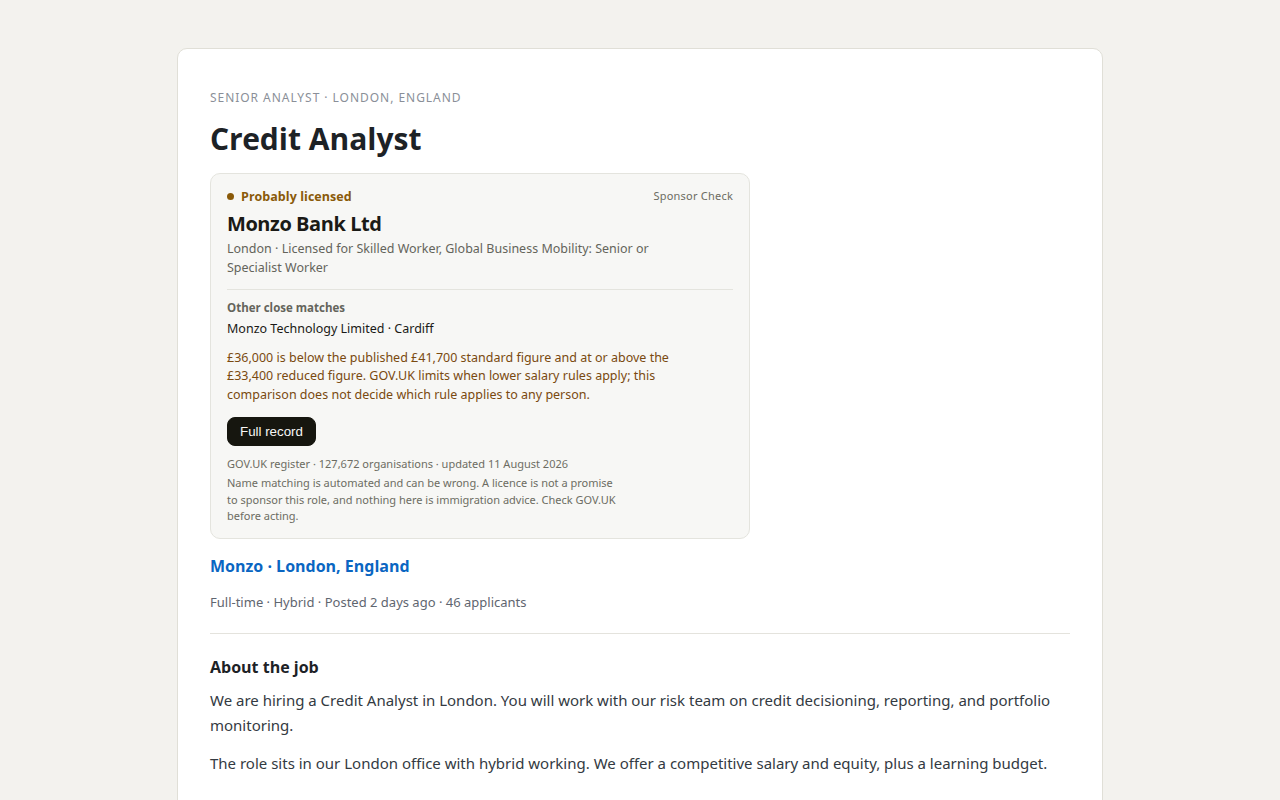
Our product. Sponsor Check is the browser extension sold by THINKINGAI LIMITED, the company identified in this site's footer. The register itself remains free, official, and public. This site is information only, not immigration advice.