UK Candidates Only: What That Job Ad Wording Means
UK candidates only, UK-based only, right to work required: what each phrase actually means, which are about sponsorship, and how to respond to each.
Quick answer
"UK candidates only" has no fixed legal meaning. Employers use it to mean at least four different things: you must already have permission to work here, you must be physically in the UK, they will not sponsor a visa, or they simply copied it from a template. Only one of those is genuinely about sponsorship. The related phrase "you must have the right to work in the UK" is usually just the employer restating a legal duty every UK employer has, not a refusal to sponsor. Because the phrases are ambiguous, the reliable move is to check the employer's licence on the public register and, where it still matters, ask one short question.
Key takeaways
- The phrase is not defined in law and different employers mean different
things by it.
- "Right to work in the UK" is a legal check every employer must run on
everyone, including British citizens.
- Getting that check wrong can cost an employer up to £60,000 per illegal
worker, which explains a lot of cautious wording.
- "We cannot offer sponsorship" is the only version that is unambiguous.
- Nationality is a protected characteristic under the Equality Act 2010;
choosing not to sponsor is a separate matter from nationality.
- A sponsor licence is permission to sponsor. It is not a promise to sponsor
any role or any person.
Why the wording is so inconsistent
Nobody wrote a standard
There is no legal template for job ads. Recruiters, HR teams, and hiring managers all write their own, and they borrow from each other. A phrase that one company uses precisely gets copied by another that means something quite different.
That is the whole explanation. It is not a code, and there is no secret meaning to decode. There is only a set of common phrases, each with a range of intended meanings.
The fear behind the caution
UK employers face real consequences for getting right-to-work wrong. Every employer must check that a person can work in the UK before they start, using an online share code, a manual document check, or an identity service provider using identity document validation technology Source: GOV.UK — Check a job applicant's right to work.
The penalties are not small. GOV.UK states a civil penalty of up to £60,000 per illegal worker, and in cases where the employer knew or had "reasonable cause to believe" the person could not work legally, up to five years in prison and an unlimited fine Source: GOV.UK — Penalties for employing illegal workers. An employer avoids the civil penalty if they can show they made the correct checks.
That is why so many ads carry a right-to-work line. It is a compliance reflex, not usually a message to international candidates.
The four things "UK candidates only" can mean
| Intended meaning | How common | What you should do |
|---|---|---|
| "You must already have permission to work here" | Very common | Check if you already qualify; ask if not |
| "You must be physically located in the UK" | Common for on-site and hybrid roles | Answer it directly if you are here |
| "We will not sponsor a visa" | Common but rarely stated this plainly | Treat as a no if confirmed |
| Copied boilerplate with no specific intent | More common than anyone admits | Ask; the answer may surprise you |
The practical consequence: the phrase on its own does not tell you whether to apply. It tells you that a question exists.
The phrase ladder, from vaguest to clearest
Level 1 — "You must have the right to work in the UK"
The vaguest and the most common. Every employer needs this to be true of every hire, including British citizens. It is very often boilerplate.
Does it rule out sponsorship? Usually not on its own.
Level 2 — "UK candidates only" / "UK-based candidates only"
Ambiguous between location and status. "UK-based" leans towards location; "UK candidates" leans towards status, but neither reliably.
Does it rule out sponsorship? Unclear. Worth one question.
Level 3 — "We are unable to provide sponsorship for this role"
Specific and about sponsorship. This is the employer telling you their policy for this vacancy.
Does it rule out sponsorship? Yes, for this role.
Level 4 — "We cannot sponsor now or in the future" / "no visa sponsorship, including switching"
The clearest form, usually written by employers who receive a lot of applications and have decided to be blunt.
Does it rule out sponsorship? Yes, and there is little point pressing.
The ladder is useful because your response should scale with clarity. Level 1 barely changes anything. Level 4 means close the tab.
Where the law actually sits
Nationality is protected; sponsorship policy is different
Under the Equality Act 2010 there are nine protected characteristics, and race is one of them — defined to include "colour, nationality, ethnic or national origin" Source: GOV.UK — Discrimination: your rights.
At the same time, GOV.UK's right-to-work guidance tells employers plainly: "You must not discriminate against anyone because of where they're from" Source: GOV.UK — Check a job applicant's right to work. The expected practice is to check every candidate the same way, rather than singling people out by name, accent, or appearance.
An employer deciding not to hold or use a sponsor licence is a different question from an employer treating people differently because of their nationality. Those two things can look similar from the outside and are not the same thing.
Where to go if something feels wrong
This site cannot tell you whether a particular ad or decision crossed a line — that depends on facts we cannot see, and it is not something a website should opine on. If you think you have experienced discrimination in recruitment, Acas provides free advice through its helpline and can refer people to the Equality Advisory and Support Service Source: Acas — Discrimination and the law.
Nothing on this page is legal, employment, or immigration advice.
What to do with each phrase
If the ad says "right to work required" and nothing else
Apply. This is the normal case and it rules out almost nobody by itself. If sponsorship is relevant to you, raise it once, early, in a neutral sentence.
If the ad says "UK candidates only"
Decide what is actually being asked. If you are already in the UK with permission to work, answer it in your first line and move on — you may well be exactly who they mean. If you would need sponsorship, treat it as a question worth asking rather than a closed door, unless the rest of the ad closes it.
If the ad says sponsorship is unavailable
Believe it and move on. Employers who write this have usually thought about it. Spending an application slot arguing with a stated policy is expensive, and your slots are limited.
If the ad says nothing at all
This is the biggest category, and it is where the register earns its keep. Check whether the employer holds a licence before you decide anything. Our guide to finding UK jobs that sponsor visas walks through the search side of this.
How to ask, in one sentence
The mistake is a long, apologetic paragraph. The better version is short, factual, and easy to answer:
"I'm interested in this role. To save us both time: would you consider candidates who need Skilled Worker sponsorship?"
That is it. It is neutral, it does not assume, and it gives a busy person a one-word way to reply.
A few things worth avoiding:
- Do not lead with your visa status in the first line of a cover letter. Lead
with the work.
- Do not ask three times in three channels. Ask once, in one place.
- Do not ask before you know whether you clear the salary and skill tests —
the answer will not help if the role was never eligible.
- Do not read a slow reply as an answer. Recruiters are slow to everyone.
Verifying instead of guessing
The register removes the guesswork from one part of this. The GOV.UK Register of Licensed Sponsors: Workers lists every organisation permitted to sponsor, their town, the routes covered, and their rating. The file published as of 11 August 2026 held 127,672 organisations Source: GOV.UK — Register of licensed sponsors: workers.
Three things to remember when you use it:
- Search the legal name. Job ads use trading names. "Boots" is not what the
register calls Boots.
- A hit is permission, not intention. Plenty of licensed organisations have
never sponsored anyone.
- A miss is not a verdict. It can mean the ad used a trading name, the
licence is newer than your copy of the file, or the employer simply does not hold one.
If the employer is not on the register, "UK candidates only" almost certainly means what it appears to mean, and no amount of asking will change it.
The salary check that comes first
Before any of this matters, the role has to be eligible. The Skilled Worker standard threshold is £41,700 a year or the going rate for the occupation, whichever is higher, with lower floors of £33,400 or £37,500 for defined groups such as new entrants and PhD holders Source: GOV.UK — When you can be paid less. Verified against GOV.UK on 6 August 2026.
Since 22 July 2025, the skill threshold has also sat at RQF level 6, roughly degree level Source: GOV.UK — Explanatory memorandum to HC 997, 1 July 2025.
An employer saying "UK candidates only" on a £28,000 role is not the obstacle. The role was not eligible for sponsorship regardless of what the ad said.
A short decision tree
- Does the salary clear the floor that applies to me? If no, stop.
- Is the occupation at the required skill level? If no, stop.
- Does the ad explicitly rule out sponsorship? If yes, stop.
- Is the employer on the register? If no, deprioritise.
- Is the employer A-rated? If B-rated, a new certificate cannot be assigned
right now.
- Everything else: apply, and ask the one-sentence question.
Steps one and two are free and take a minute. Steps four and five are free and take another minute. Most of the anguish about ad wording happens because people start at step three.
Where you see the phrase most, and why
The wording is not spread evenly across the market. Knowing where it clusters tells you how much weight to give it.
Small employers
The phrase appears far more often on ads from companies under about fifty people. That is usually cost rather than principle. A five-year Skilled Worker sponsorship costs a medium or large employer £525 for the certificate plus up to £6,600 in Immigration Skills Charge, and a small or charitable sponsor up to £2,400 Source: GOV.UK — Immigration skills charge. Add legal fees and the administrative duties of holding a licence, and a small firm that has never sponsored will often write the phrase to avoid a conversation it does not know how to have.
Agencies
Recruitment agencies use the phrase more than direct employers, partly as a filter on volume and partly because the agency does not always know the client's position. An agency saying "UK candidates only" may simply mean it has not asked.
This is worth one question, because the answer is often "let me check". See our guide to recruitment agencies versus direct employers.
Public sector and regulated roles
Some roles genuinely require existing status for reasons unconnected to sponsorship — security clearance being the common one. Where the ad names a clearance requirement, the constraint is real and separate from the employer's licence.
Sectors that sponsor routinely
Universities, NHS trusts, and large engineering, technology, and financial firms sponsor frequently and still carry right-to-work boilerplate on almost every ad. This is the clearest evidence that the phrase is not a reliable signal: the employers most likely to sponsor use it too.
What to write back
The response should be short enough to read on a phone and specific enough to answer in one word.
If you already have permission to work
Lead with it and remove the ambiguity immediately.
"I hold [status] with the right to work in the UK, so no sponsorship is needed. Happy to share a share code for the right-to-work check whenever that stage comes."
Mentioning the share code is a small signal that you know how the check works, which is exactly what the employer was anxious about.
If you would need sponsorship
"I'm based in [location] and would need Skilled Worker sponsorship. I've checked the salary and skill level and the role looks eligible — is sponsorship something you'd consider for this position?"
Naming the route and the checks you have already done does two things: it shows the question is informed, and it makes the yes-or-no easy to give.
If the ad is ambiguous and the employer is on the register
"The ad mentions UK candidates — could I check whether that's about location or about sponsorship? I'm [in the UK / would need Skilled Worker sponsorship]."
Do not quote the register at them. It reads as gotcha, and it is unnecessary — you only need their answer, not proof that they could have said yes.
What not to write
- Long explanations of your immigration history. Nobody is reading paragraph
three.
- Anything that sounds like a legal argument about discrimination. If you have
a genuine concern, that belongs with Acas, not in a covering email.
- A follow-up two days later. Recruiters are slow to everyone, and a chase this
early reads badly.
The bottom line
"UK candidates only" is four different sentences wearing the same coat. One of them is about sponsorship; the rest are about status, location, or a copied template.
So stop trying to read the ad and start reading the register. Check the salary, check the skill level, check whether the employer holds a licence and at what rating, and then — only if it still matters — ask one short question of one human being.
This page is information, not legal, employment, or immigration advice. This site is not affiliated with the Home Office or GOV.UK. For your own circumstances, check GOV.UK or speak to an adviser registered with the Immigration Advice Authority or a regulated solicitor.
Frequently asked questions
What does "UK candidates only" mean on a job ad?
It has no fixed legal meaning. Employers use it to mean you must already have permission to work here, you must be located in the UK, they will not sponsor, or it is copied boilerplate. Only the third is definitely about sponsorship.
Does "must have the right to work in the UK" mean no sponsorship?
Usually not. Every UK employer must check that every new hire can work here, including British citizens, so the phrase is very often a compliance statement rather than a policy on sponsorship.
Is "UK candidates only" legal?
There is no rule banning the phrase itself, and employers are not obliged to hold or use a sponsor licence. Nationality is a protected characteristic under the Equality Act 2010, so how a policy is applied can matter. Whether any specific case crosses a line is a question for Acas or a qualified adviser, not for a website.
Should I apply if the ad says UK candidates only?
If you already have permission to work in the UK, yes, and say so in your first line. If you need sponsorship, it depends on what else the ad says and whether the employer is on the register. Ask once if it is still unclear.
Why do employers write these phrases if they do sponsor?
Because the ad is written for everyone, ads are copied between roles, and the legal right-to-work duty applies to every hire. Plenty of licensed sponsors carry right-to-work boilerplate on every vacancy.
What is the clearest way to ask about sponsorship?
One neutral sentence, early: would you consider candidates who need Skilled Worker sponsorship? Short questions get answered; long ones get postponed.
Can an employer refuse to sponsor me?
Yes. Holding a licence gives an employer permission to sponsor, not an obligation. A licence is not a promise to sponsor any role or any person.
What are the penalties if an employer gets right to work wrong?
Up to £60,000 per illegal worker as a civil penalty, and up to five years in prison with an unlimited fine where the employer knew or had reasonable cause to believe. An employer who made the correct checks avoids the civil penalty.
Does "UK-based" mean the same as "UK candidates only"?
Not quite. "UK-based" leans towards physical location, which matters for on-site and hybrid roles. "UK candidates" leans towards status. Neither is used consistently enough to rely on.
Where can I get help if I think a job ad discriminated against me?
Acas offers free advice through its helpline and can refer people to the Equality Advisory and Support Service. This site cannot assess an individual case.
Does the sponsor register tell me if an employer will sponsor?
No. It tells you whether they are permitted to. Whether they will, for your role, is a decision only the employer can give you.
What if the employer is not on the register at all?
Then sponsorship is not available from them today, whatever the ad says. Try the legal name before concluding, because trading names often miss.
Is it worth applying to a B-rated sponsor?
They cannot issue new certificates of sponsorship until they return to an A rating, though they can still issue them to existing employees extending their stay. Applying is not wasted if your timeline is flexible, but check the register again before later stages.
Should I mention my visa status in my CV?
Keep the CV about the work. If your status is straightforward — for example you already hold permission to work — one short line saves everyone time. If you need sponsorship, raise it in the message rather than the CV.
How many times should I follow up?
Once, after a reasonable gap. Repeated follow-ups across email, the job board, and social channels rarely change the answer and can change how you are seen.
Last reviewed 2026-08-06 by Visa Ready UK Editorial Team. Figures on this page are checked against GOV.UK on the review date. Rules, fees, and salary floors change — always confirm against GOV.UK before you act. Spotted an error?
Check the employer without leaving the job advert
- See the legal sponsor name, town, routes, rating, and close matches on the page.
- Your checks and job-page text stay on your computer; the extension makes no network requests.
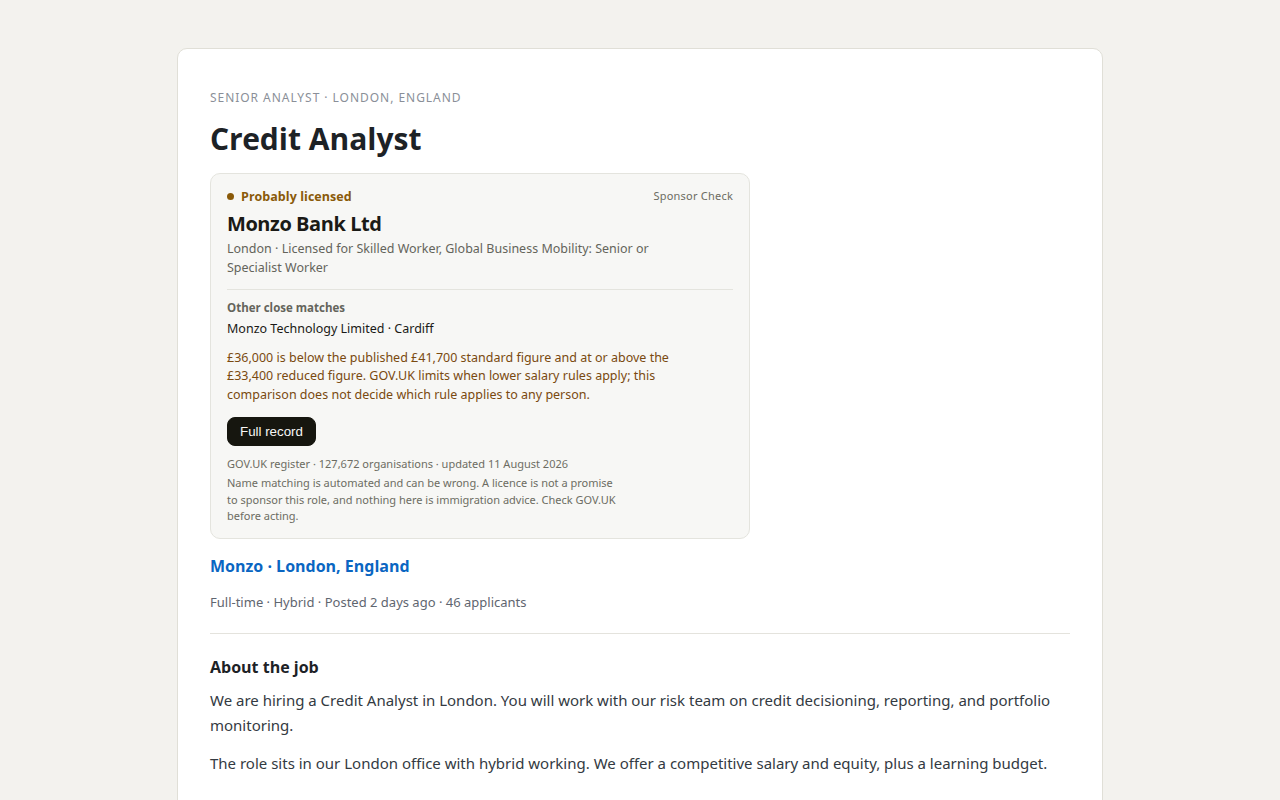
Our product. Sponsor Check is the browser extension sold by THINKINGAI LIMITED, the company identified in this site's footer. The register itself remains free, official, and public. This site is information only, not immigration advice.
Sources
- Check a job applicant's right to work — GOV.UK
- Penalties for employing illegal workers — GOV.UK
- Discrimination: your rights — GOV.UK
- Discrimination and the law — Acas
- Register of licensed sponsors: workers — GOV.UK
- Skilled Worker visa: when you can be paid less — GOV.UK
- Explanatory memorandum to the statement of changes to the Immigration Rules: HC 997 — GOV.UK
- Find an immigration adviser — GOV.UK