When and How to Ask About Sponsorship at Interview
When to raise visa sponsorship in a UK hiring process, the exact words to use at each stage, and how to read the answer you get back.
Quick answer
Ask about sponsorship at the application stage in one neutral sentence, and never later than the first conversation with a human. Asking early costs you nothing and saves weeks; asking late wastes your time and irritates employers who would have told you at the start. The exception is when the ad already says sponsorship is available, in which case confirm the practical details — defined or undefined certificate, and expected timing — at offer stage instead. Before you ask anything, check the employer on the public sponsor register and check the salary against the going rate, because the answer to "will you sponsor" is irrelevant if the role was never eligible.
Key takeaways
- Ask once, early, in one sentence. Repetition does not improve the answer.
- Do your own homework first: licence, rating, salary, skill level.
- "We'd have to look into it" usually means no licence, not reluctance.
- A B-rated sponsor cannot assign a new certificate right now, whatever they
intend.
- At offer stage, the useful questions are about the certificate type and
timing, not about willingness.
- Nothing an employer says at interview guarantees a visa outcome. No one can
promise that.
- A sponsor licence is permission to sponsor, not a promise to sponsor any role
or any person.
The case for asking early
Late questions cost you, not them
The instinct is to delay: build rapport, prove your value, then raise the awkward thing. It feels strategic. In practice it usually backfires.
An employer without a licence cannot sponsor you no matter how good the fourth interview goes. If you find that out at offer stage, you have spent four rounds, several days of preparation, and possibly annual leave. The employer has spent time too, and the conversation that follows is worse for both of you than the one you could have had in week one.
Early questions signal competence, not weakness
There is a persistent worry that mentioning sponsorship marks you as high-maintenance. In reality, an employer who sponsors regularly will read a clear, early question as a sign that you understand the process. An employer who does not sponsor will be relieved you asked.
The only people put off by a well-phrased early question are people who were never going to sponsor. That is useful information, delivered cheaply.
The one exception
If the ad explicitly says sponsorship is available, you do not need to ask whether. You need to ask how it will run — and that conversation belongs at offer stage, when there is something concrete to schedule.
Do this before you ask anything
Check the licence
Look the employer up on the GOV.UK Register of Licensed Sponsors: Workers. The file published as of 11 August 2026 held 127,672 organisations Source: GOV.UK — Register of licensed sponsors: workers.
Search the legal name, not the brand on the ad. If nothing matches, look the legal name up on Companies House first Source: GOV.UK — Find and update company information, then search again.
Check the rating
An A-rated sponsor can assign certificates normally. A B-rated sponsor cannot issue new certificates until it upgrades back to A, though it can still issue them to existing employees extending their permission to stay Source: GOV.UK — Your licence rating.
This changes what you should ask. At a B-rated sponsor, "will you sponsor" is the wrong question. "What's your expected timeline for assigning a certificate" is the right one.
Check the salary and skill level
The Skilled Worker standard threshold is £41,700 a year or the going rate for the occupation, whichever is higher. Lower floors of £33,400 and £37,500 apply to defined groups such as new entrants, students and recent graduates, and PhD holders Source: GOV.UK — When you can be paid less. Verified against GOV.UK on 6 August 2026.
Since 22 July 2025 the skill threshold has sat at RQF level 6 Source: GOV.UK — Explanatory memorandum to HC 997, 1 July 2025.
If the role fails either test, the sponsorship question is moot. Our guide to reading a UK job ad covers how to run these checks in about ninety seconds.
What to say, stage by stage
At application
One sentence, at the end of a cover note or in the application's free-text field. Not the opening line — the work comes first.
"One practical note: I would need Skilled Worker sponsorship. Happy to talk through the details if that works for you."
Why it works: it is factual, it is short, it names the route, and it hands control back to them.
In a recruiter screen
Recruiters usually raise it themselves. If they do not, ask near the end, after you have covered the role:
"Before we go further — is this role open to candidates who need Skilled Worker sponsorship?"
Recruiters appreciate this because a mismatch discovered later reflects on them. Internal recruiters will normally know the answer immediately. Agency recruiters may need to check with the client, which is a legitimate answer.
With a hiring manager
Hiring managers often do not know the company's sponsorship position, and guessing puts them in a bad spot. Ask in a way that lets them defer:
"Is sponsorship something you've done in this team before, or would that be a question for HR?"
This gets you a useful answer either way. "We've sponsored two people on this team" is a strong signal. "I'd have to ask HR" is neutral. "I don't think we do that" from a manager is not authoritative — verify against the register before you write the company off.
At offer stage
Now switch from whether to how. Four questions, in order of usefulness:
- Would the certificate be defined or undefined? Defined applies to Skilled
Worker applicants from outside the UK and is usually approved within one working day. Undefined applies inside the UK and to other routes, where extra allocation requests usually take around 12 weeks unless the employer pays for the expedited service Source: GOV.UK — Certificates of sponsorship.
- When do you plan to assign it? You must apply within three months of
assignment, and cannot apply more than three months before the start date. Both windows come from the same GOV.UK page.
- Which occupation code will be used? It sets the going rate that your
salary is measured against.
- Who handles this internally? A named person beats a shared inbox.
These are scheduling questions. They are entirely normal at offer stage, and an experienced employer will have answers ready.
Reading the answer you get
| What they say | What it usually means | What to do |
|---|---|---|
| "Yes, we sponsor for this role" | They have a licence and have decided | Verify on the register, then proceed |
| "We'd have to look into it" | Often no licence, sometimes no recent experience | Check the register yourself |
| "We've sponsored before but not for this role" | Licence exists; budget or policy is the blocker | Ask what would change that |
| "Not for this position" | A decision about this vacancy | Believe it; ask about future roles once |
| "We don't sponsor" | Company policy | Move on |
| Silence after you ask | Usually workload, occasionally avoidance | Follow up once, then move on |
The most misread answer is "we'd have to look into it". It sounds open-minded. Usually it means nobody in the room knows whether the company holds a licence — which the register can tell you in thirty seconds.
Mistakes that cost people roles
Apologising
"I'm so sorry, I know this is a hassle, but unfortunately I would need sponsorship…" invites the reader to agree that it is a hassle. State it, do not apologise for it.
Asking everywhere at once
Email, the application form, LinkedIn, and a follow-up call within three days does not read as keen. Ask in one place and wait.
Leading with it
Your first sentence should be about the work. Sponsorship is a logistical detail attached to a strong candidate, not the headline.
Negotiating against a stated no
If an employer has written "we cannot offer sponsorship", a persuasive email will not change it. That decision usually sits above the person reading your message.
Accepting a promise as a fact
An enthusiastic hiring manager saying "we'll sort the visa" is not a certificate of sponsorship, and no employer can promise a visa outcome. UKVI decides. Keep the enthusiasm and verify the mechanics.
Paying anyone
No employer or agency may charge you for a job, a certificate of sponsorship, or the Immigration Skills Charge. GOV.UK is explicit that the employer pays both the £525 certificate fee and the skills charge, and cannot recover them from the worker Source: GOV.UK — Immigration skills charge. Charging a work-seeker a fee to find them work is also a breach of the rules the Fair Work Agency enforces, and complaining to them is free Source: GOV.UK — Making a complaint about your recruitment agency.
What employers are actually weighing
Understanding the other side makes your questions sharper.
| Cost to the employer | Amount |
|---|---|
| Certificate of sponsorship, Worker routes | £525 |
| Immigration Skills Charge, medium or large sponsor | £1,320 for the first 12 months, £660 per further 6 months |
| Immigration Skills Charge, small or charitable sponsor | £480 for the first 12 months, £240 per further 6 months |
| Maximum skills charge across five years | £6,600 large, £2,400 small |
All from GOV.UK, verified 6 August 2026. Add legal fees and the administrative burden of sponsor duties, and the reluctance of a twelve-person company becomes easier to read as economics rather than prejudice.
Some sponsorships are exempt from the skills charge, including scientific research occupations, research and development managers, higher education teaching professionals, and workers switching from a Student visa. If you fall into one of those, saying so is genuinely useful information for a hesitant employer — and it is a fact about the rules, not a pitch.
Questions worth asking that people forget
- "Has the team sponsored before?" — experience reduces friction more than
willingness does.
- "Is the start date flexible?" — the three-month windows make timing real.
- "What happens if the application takes longer than expected?" — GOV.UK gives
indicative times of three weeks from outside the UK and eight weeks inside it Source: GOV.UK — Skilled Worker visa.
- "Who is the sponsoring legal entity?" — especially for remote roles or groups
with several companies.
A short script you can adapt
Application note. "Thanks for considering my application. One practical note: I would need Skilled Worker sponsorship. I have checked that the role appears to meet the salary and skill requirements, and I am happy to talk through timings."
Recruiter screen. "Before we go further — is this role open to candidates who need Skilled Worker sponsorship?"
Offer stage. "Delighted, thank you. Two logistics questions so I can plan: would the certificate be defined or undefined, and when would you expect to assign it?"
Short, specific, and never apologetic.
When they ask you first
Most structured processes ask the question on the application form, usually in one of two shapes.
"Do you have the right to work in the UK?"
Answer factually. If you already hold permission to work, the answer is yes, and you do not need to volunteer more.
"Will you now or in the future require sponsorship?"
This one catches people out, because the honest answer is often yes even for someone who can work today. Someone on a Graduate visa can work now and will need sponsorship when it ends.
Answer it truthfully. Getting hired on a misleading answer creates a problem later that is far worse than the rejection you avoided, and employers have real reasons to care: a wrong right-to-work position carries a civil penalty of up to £60,000 per illegal worker, and up to five years in prison in serious cases Source: GOV.UK — Penalties for employing illegal workers.
If there is a free-text box, one clarifying line helps:
"I can work in the UK until [date] on a [route] visa, and would need Skilled Worker sponsorship after that."
That converts a scary yes into a manageable timeline.
If it comes up unprompted in conversation
Answer plainly, then return to the work. A useful shape:
"Yes — I'd need Skilled Worker sponsorship. I've checked the salary and skill level and it looks eligible. Shall I come back to the [technical question we were on]?"
Acknowledging and moving on signals that you do not regard it as the most interesting thing about you.
Following up in writing
Verbal answers about sponsorship evaporate. A short written confirmation after a call protects everyone, and it is a normal thing to send.
"Thanks for the call. Just to confirm what we discussed: the role is open to candidates needing Skilled Worker sponsorship, and you'd expect to assign the certificate around [timing]. Do shout if I've got any of that wrong."
Three reasons this is worth doing:
- It creates a record you can point at if the process passes to someone
else, which it usually does.
- It surfaces misunderstandings early, while they are cheap to fix.
- It prompts a correction if the person you spoke to was guessing.
Keep it to four lines. A long email invites a slow reply.
Timing the whole thing backwards
If an offer is likely, work back from the start date rather than forward from today:
| Step | Typical timing |
|---|---|
| Visa decision | 3 weeks outside the UK, 8 weeks inside |
| Application preparation, biometrics, documents | 1–2 weeks |
| Certificate assigned | Same week for a defined certificate at an experienced sponsor |
| Certificate must be used | Within 3 months of assignment |
| Earliest you can apply | 3 months before the start date |
Processing times are GOV.UK's indicative figures Source: GOV.UK — Skilled Worker visa; the two three-month windows come from the certificates of sponsorship page.
Put those numbers in your first offer-stage email. A start date that looked generous often turns out to be tight, and the employer would usually rather know in week one than week six.
The bottom line
Do the free checks first — licence, rating, salary, skill level — because they answer more than any conversation will. Then ask once, early, in one sentence, and let the answer be the answer.
At offer stage, switch from whether to how: defined or undefined, when, which code, who owns it. Those four questions are what separate a smooth start date from a three-month scramble.
This page is information, not immigration or employment advice. This site is not affiliated with the Home Office or GOV.UK. For your own circumstances, check GOV.UK or speak to an adviser registered with the Immigration Advice Authority or a regulated solicitor.
Frequently asked questions
When should I ask about visa sponsorship?
At application, or at the latest in your first conversation with a person. Ask once, in one sentence. Late questions cost you rounds of interviews that could never have led anywhere.
Will asking about sponsorship hurt my chances?
With an employer who sponsors, a clear early question generally reads as competence. With an employer who does not, it saves you both time. The people put off by the question were not going to sponsor.
How do I ask an employer for sponsorship?
Use one neutral sentence naming the route: would you consider candidates who need Skilled Worker sponsorship? Keep the work first and the logistics second.
What if the employer says they would have to look into it?
Check the register yourself. That answer usually means nobody present knows whether the company holds a licence, and the register answers it in seconds.
Can an employer promise me a visa?
No. A certificate of sponsorship is one input; UKVI decides the application. No employer or adviser can promise an outcome.
What should I ask once I have an offer?
Whether the certificate is defined or undefined, when they plan to assign it, which occupation code will be used, and who handles the process internally.
How long does a certificate of sponsorship take?
A defined certificate, used for Skilled Worker applicants outside the UK, is usually approved within one working day. Extra undefined allocation requests usually take around 12 weeks, or five working days on the expedited service.
Do I have to pay for my sponsorship?
No. The employer pays the £525 certificate fee and the Immigration Skills Charge, and GOV.UK states these cannot be recovered from the worker.
What if the company is B-rated?
They cannot assign a new certificate until they return to an A rating. Ask about timelines rather than willingness, and check the register again before committing more time.
Should I mention sponsorship in my CV?
Keep the CV about your work. Put the sponsorship note in the covering message, where it can be phrased properly.
How many times should I follow up?
Once, after a reasonable gap. Asking repeatedly across several channels rarely changes the answer.
Is it worth asking about future roles if they say no to this one?
Once, briefly, and then leave it. "If sponsorship becomes possible for future openings, I'd be glad to hear about it" is enough.
Does an employer being on the register mean they will sponsor me?
No. It means they are permitted to. A licence is not a promise to sponsor any role or any person, and many licensed organisations sponsor rarely or never.
What if the recruiter will not name the employer?
That is common early on. You can ask whether the end employer holds a sponsor licence without needing the name, and most consultants will tell you.
Can I be charged a fee by an agency to find me work?
No. Charging a work-seeker a fee to find them work is a breach of the rules enforced by the Fair Work Agency, which took over from the Employment Agency Standards Inspectorate on 7 April 2026. Complaints to the FWA are free.
Last reviewed 2026-08-06 by Visa Ready UK Editorial Team. Figures on this page are checked against GOV.UK on the review date. Rules, fees, and salary floors change — always confirm against GOV.UK before you act. Spotted an error?
Check the employer without leaving the job advert
- See the legal sponsor name, town, routes, rating, and close matches on the page.
- Your checks and job-page text stay on your computer; the extension makes no network requests.
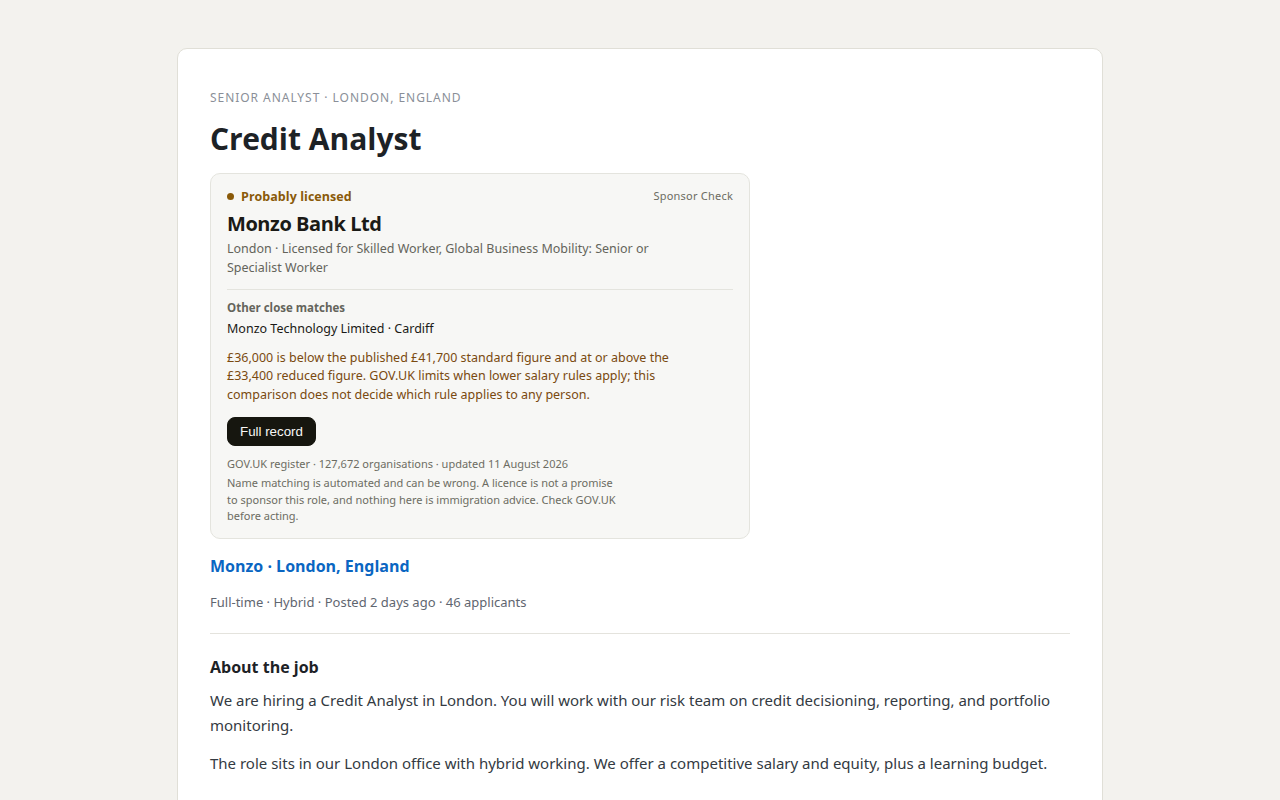
Our product. Sponsor Check is the browser extension sold by THINKINGAI LIMITED, the company identified in this site's footer. The register itself remains free, official, and public. This site is information only, not immigration advice.
Sources
- Register of licensed sponsors: workers — GOV.UK
- Your licence rating — GOV.UK
- Certificates of sponsorship — GOV.UK
- Immigration skills charge — GOV.UK
- Skilled Worker visa: when you can be paid less — GOV.UK
- Skilled Worker visa — GOV.UK
- Explanatory memorandum to the statement of changes to the Immigration Rules: HC 997 — GOV.UK
- Making a complaint about your recruitment agency — GOV.UK
- Find and update company information — Companies House
- Find an immigration adviser — GOV.UK