UK CV Tailoring When You Need Visa Sponsorship
How a UK CV differs from the one you have, what to say about right to work, and how to describe duties so the role's occupation code is obvious to a recruiter.
Quick answer
A UK CV is two pages, has no photograph, no date of birth, no marital status and no nationality line, and leads with a short profile followed by reverse chronological experience. When you need sponsorship, three edits matter more than layout: describe duties in the language of the occupation, state your right to work position accurately and briefly rather than hiding or over-explaining it, and make the evidence for your seniority explicit, because a recruiter is matching your experience against a salary floor as well as a job description. Never misdescribe your status or your work — employers are legally required to check, and inaccuracy is the one mistake that cannot be recovered.
Key takeaways
- Two pages, reverse chronological, no photo, no personal data beyond contact
details.
- UK employers must carry out a right to work check on whoever they hire. Your
CV does not have to pre-empt it, but it must never contradict it.
- Duties drive the occupation code, which drives the salary rules. Write duties,
not adjectives.
- Quantify seniority. "Led a team of six" does more work than "senior".
- One line on status, placed deliberately, is usually enough.
- Discrimination on the basis of where someone is from is prohibited, and
employers are told so in the government's own guidance.
- A sponsor licence is permission to sponsor, not a promise to sponsor any role
or any person. A perfect CV does not change that.
The structural differences from most non-UK CVs
If your CV was written for another market, the quickest improvements are structural and take an afternoon.
| Element | Common elsewhere | UK convention |
|---|---|---|
| Length | 1 page or 4+ pages | 2 pages for most roles |
| Photograph | Frequently included | Omitted |
| Date of birth, marital status, gender | Sometimes included | Omitted |
| Nationality | Sometimes a field | Not a field; status handled separately if at all |
| Objective statement | "Seeking a challenging role…" | A short factual profile instead |
| References | Listed in full | "References available on request", or omitted |
| Spelling | Any | UK spelling: organised, programme, analyse |
| Dates | Various | Month and year, consistently formatted |
The personal-data omissions are not politeness. UK employers generally prefer not to hold that information at application stage, and its absence removes any suggestion that a decision turned on it.
The profile: four lines, no adjectives
The block at the top of a UK CV is a factual summary, not a pitch. Four lines is plenty:
- What you are, in the language of the occupation.
- Years of relevant experience and the domains.
- Two or three concrete capabilities, ideally with scale attached.
- What you are looking for, in one clause.
Compare:
Dynamic and results-driven professional with a passion for excellence, seeking a challenging position in a forward-thinking organisation.
with:
Mechanical design engineer, seven years in automotive tier-one suppliers. Owns CAD-to-production handover for assemblies of 60–200 parts; led validation for two vehicle programmes. Looking for a design or validation role in the Midlands.
The second version is shorter and tells a recruiter which occupation you sit in, what scale you work at, and where you want to be. Those are the three things they need in order to place you against a vacancy.
Writing duties so the occupation is obvious
This is the edit that matters most when sponsorship is involved, and almost nobody makes it.
Under the Skilled Worker rules, a sponsored role is assigned an occupation code based on the duties actually performed. That code determines the going rate the salary must meet, alongside the general threshold — £41,700 a year or the going rate, whichever is higher, with lower floors from £33,400 for defined groups Source: GOV.UK — Skilled Worker visa: your job, verified against GOV.UK on 6 August 2026.
So when a recruiter reads your CV against a vacancy, they are implicitly asking whether your experience matches the occupation they are hiring for, not just the job title. Help them:
- Use occupation language, not internal jargon. "Ran the CI pipeline" is
internal. "Build and release engineering for a 40-service platform" is occupational.
- Lead each bullet with the verb that names the work. Designed, specified,
validated, forecast, audited, diagnosed, supervised.
- Attach scale to seniority claims. Team size, budget, throughput, users,
sites, caseload.
- Cut the adjectives. "Complex", "fast-paced", "cutting-edge" and
"challenging" carry no information.
A before-and-after
Responsible for various finance duties in a fast-paced environment, supporting senior stakeholders with ad-hoc analysis.
Management accountant for two trading entities (combined turnover £18m). Owned month-end close, variance analysis and the rolling 13-week cash forecast; supervised one part-qualified accountant.
The second version reads as a specific occupation at a specific level. The first could be almost anything, which is exactly why it fails.
What to say about right to work, and where
There is no single correct answer, but there are wrong ones. Three positions work, and the choice depends on where you are in the process.
Option one: say nothing on the CV
Defensible and common. A CV is a record of your experience. Application forms almost always ask the right-to-work question directly, and answering it there is accurate and sufficient.
Option two: one factual line
A short line at the end of the personal details, or at the foot of page two:
Right to work: currently on a UK Graduate visa, valid until [month/year].
Right to work: would require sponsorship for a UK role.
Neither sentence apologises or over-explains. Employers who cannot sponsor find out sooner, which saves you both time. Employers who can move on to the next line.
Option three: address it in the cover letter instead
Useful when your situation needs one sentence of context that would look odd on a CV — for example, that you are already in the UK and are switching from another route. Keep it to one sentence and keep it factual.
What never works
- Omitting or blurring your status when a form asks directly.
- Implying you hold status you do not hold.
- Long explanations of immigration rules on the CV. A recruiter is not going to
adjudicate them, and it displaces evidence about your work.
Accuracy is not only an ethical point. UK employers must carry out a right to work check before employment starts, using an online share code, a manual document check, or an identity service provider using identity document validation technology, and must keep records during employment and for two years after it ends Source: GOV.UK — Check a job applicant's right to work. The check happens. A CV that conflicts with it fails at the point where it is most expensive to fail.
Discrimination, and what the guidance actually says
Candidates often assume that mentioning sponsorship invites unlawful treatment and therefore say nothing anywhere. It is worth knowing what the official guidance says to employers: "You must not discriminate against anyone because of where they're from," on the same page that sets out the checking duty.
That does not mean an employer must sponsor. Sponsorship is a business decision, and an employer without a licence cannot sponsor at all. It does mean the guidance directs employers to run consistent checks on everyone rather than screening by nationality assumptions.
The practical takeaway is calmer than the anxiety: state your position accurately when asked, put your energy into the evidence of your work, and treat an employer's inability to sponsor as information rather than judgement. Our guide to job ads that rule out sponsorship covers how to read those statements.
The tailoring pass, per application
Rewriting a CV from scratch for each role is unsustainable. A twenty-minute pass is not.
- Read the advert's duties, not its title. Our
guide to reading a UK job ad sets out the order to read in.
- Reorder your bullets so the three that match the advert's core duties sit
at the top of the relevant role.
- Mirror the advert's nouns. If it says "stakeholder reporting", use that
phrase where it is true of your work.
- Adjust the profile's first line to name the occupation the advert names.
- Check the seniority evidence matches the level implied by the salary
band.
- Leave everything else alone.
Steps two and three are where nearly all the benefit sits. Steps four and five are the difference between a plausible application and an obvious one.
Formatting so a machine can read it
Recruiting systems parse your document into fields. If parsing fails, your experience is not searchable, which is a quieter failure than rejection.
Safe choices:
- A single-column layout. Tables and side columns break parsing.
- Standard section headings: Profile, Experience, Education, Skills.
- Real text, never text inside an image or a graphic.
- Dates as "Mar 2022 – Aug 2024", consistently.
- A common font, and no header/footer for critical content.
- A
.docxor a text-based PDF, and never a scanned one.
Name the file properly too: Firstname-Lastname-CV.pdf. It ends up in a folder with hundreds of others.
UK-specific details that get missed
Qualifications. State the qualification, the awarding institution, and the country. If you want to indicate a UK equivalence, describe it as an equivalence rather than asserting a UK award you were not given.
Grades. UK degree classifications (First, 2:1) mean nothing to most international qualifications and vice versa. Give the local grade and, if it helps, the scale: "GPA 3.7/4.0".
Addresses. A full postal address is unnecessary. City and country is enough, and "London, UK" or "Lagos, Nigeria (relocating to the UK)" is more useful than a street.
Phone numbers. Include the country code. A UK number is not required and its absence is not a signal.
Gaps. Explain them in one clause, without drama. "Career break — relocation" is complete.
Referees. Do not list names and numbers on the document. "References available on request" or nothing at all.
What a CV cannot do
It cannot make a role eligible. If the occupation sits below the skill threshold or the salary is under the applicable floor, no wording changes the outcome.
It cannot tell you whether the employer holds a sponsor licence. That comes from the official Register of Licensed Sponsors: Workers, which lists organisations permitted to sponsor, with their town, rating, and routes Source: GOV.UK — Register of licensed sponsors: workers. Our copy of the file, published as of 11 August 2026, holds 127,672 organisations.
And it cannot convert a licence into an offer. A licence is permission to sponsor, not a promise to sponsor any role or any person. Checking the register before you tailor a CV is the step that stops you spending an evening on an application that had nowhere to go — our guide to finding UK jobs that sponsor visas covers the order to work in.
The skills section, and what belongs in it
A skills list is a search index, not a self-assessment. Recruiters and their systems search it for terms; nobody reads it for insight.
What belongs:
- Named technologies, methods, standards, tools, and languages you have used in
work, with no rating scale attached.
- Regulatory or professional frameworks relevant to the occupation — GMP, IFRS,
RIBA stages, ITIL, whatever your field's are.
- Professional registration or membership, with the body named.
- Languages, with a plain proficiency word.
What does not:
- Star ratings and percentage bars. They mean nothing consistent and they break
parsing.
- Soft-skill nouns — "communication", "teamwork", "leadership". Every candidate
claims them and none of them are searchable in a useful way.
- Anything you would not be comfortable being asked about in the first ten
minutes of an interview.
Keep it to two lines of comma-separated terms per grouping, and put the groupings in the order the advert emphasises them.
Two versions, not twenty
Maintaining a separate CV per application collapses within a fortnight. What works is a small number of base versions, each aimed at an occupation rather than an employer.
If you are genuinely open to two distinct occupations — say, data analyst and data engineer — keep one base CV for each, because the duties you lead with differ. Then apply the twenty-minute tailoring pass on top of whichever base fits the advert.
Version-control it in the crudest possible way: a folder per occupation, files named with the employer and the date, and the sent version kept exactly as sent. When an interviewer asks about something on page two, you want the document they actually have.
A short checklist
- Two pages, single column, no photo, no personal data.
- Profile names the occupation in its first four words.
- Every role's top three bullets match the advert's duties.
- Seniority claims carry numbers.
- UK spelling throughout, dates consistent.
- Right-to-work position stated accurately, or left to the application form.
- File named with your name, saved as text-based PDF or
.docx. - No claim on the document that a right to work check would contradict.
The bottom line
Fix the structure once — two pages, single column, no personal data, UK spelling — and then spend your effort on two things per application: duties written in the language of the occupation, and seniority evidenced with numbers. Handle right to work in one accurate line, or leave it to the form that asks.
Then check the employer against the official register before you invest the evening, and keep the limits in view. A licence is permission to sponsor, not a promise to sponsor any role or any person.
This page is information, not immigration advice. This site is not affiliated with the Home Office or GOV.UK. For your own circumstances, check GOV.UK or speak to an adviser registered with the Immigration Advice Authority or a regulated solicitor.
Frequently asked questions
Should I put my visa status on my CV?
You can, in one factual line, or you can leave it to the application form, which almost always asks. What matters is that whatever you say is accurate.
How long should a UK CV be?
Two pages for most roles. Academic and some senior technical CVs run longer by convention, but two pages is the default expectation.
Do UK CVs include a photo?
No. Photographs, dates of birth, marital status and similar personal details are conventionally left off UK CVs.
Will saying I need sponsorship get my CV rejected?
An employer that cannot sponsor cannot hire you regardless, so an early "no" costs you nothing but time already saved. An employer that can sponsor is looking at your experience.
Is it illegal for an employer to reject me because I need sponsorship?
Sponsorship is a business decision and an unlicensed employer cannot sponsor at all. Separately, the government's guidance to employers says they must not discriminate against anyone because of where they are from. If you think you have been treated unlawfully, that is a question for a qualified adviser.
What is the most important CV change for sponsored roles?
Describing duties in the language of the occupation rather than in internal job-title language, because the occupation is what a recruiter is matching against the vacancy and its salary rules.
Should I use a CV template with columns and icons?
Single-column layouts parse more reliably in recruiting systems. Decorative templates risk your experience being stored as unsearchable text.
PDF or Word?
Either, as long as the PDF is text-based rather than a scan. If an application form specifies a format, follow it.
Do I need a UK address or phone number?
No. City and country is enough, and any working phone number with a country code is fine.
How do I present a non-UK degree?
Name the qualification, the institution and the country. If you describe a UK equivalence, present it as an equivalence rather than as a UK award.
Should I write a cover letter as well?
If one is invited, yes, and it is the natural place for one sentence of context about your situation that would sit awkwardly on a CV.
How do I handle a career gap?
One clause, factual, no apology. Recruiters see gaps constantly; unexplained ones simply invite a question.
Does tailoring actually change anything?
Reordering bullets to match the advert's duties makes the match visible in the few seconds a CV is first scanned. Nobody can promise an outcome from it, but the alternative is asking a reader to do that work for you.
What should I never do?
Misstate your right to work position or your experience. Employers are required to check the first, and the second surfaces at reference or interview stage.
Last reviewed 2026-08-08 by Visa Ready UK Editorial Team. Figures on this page are checked against GOV.UK on the review date. Rules, fees, and salary floors change — always confirm against GOV.UK before you act. Spotted an error?
Check the employer without leaving the job advert
- See the legal sponsor name, town, routes, rating, and close matches on the page.
- Your checks and job-page text stay on your computer; the extension makes no network requests.
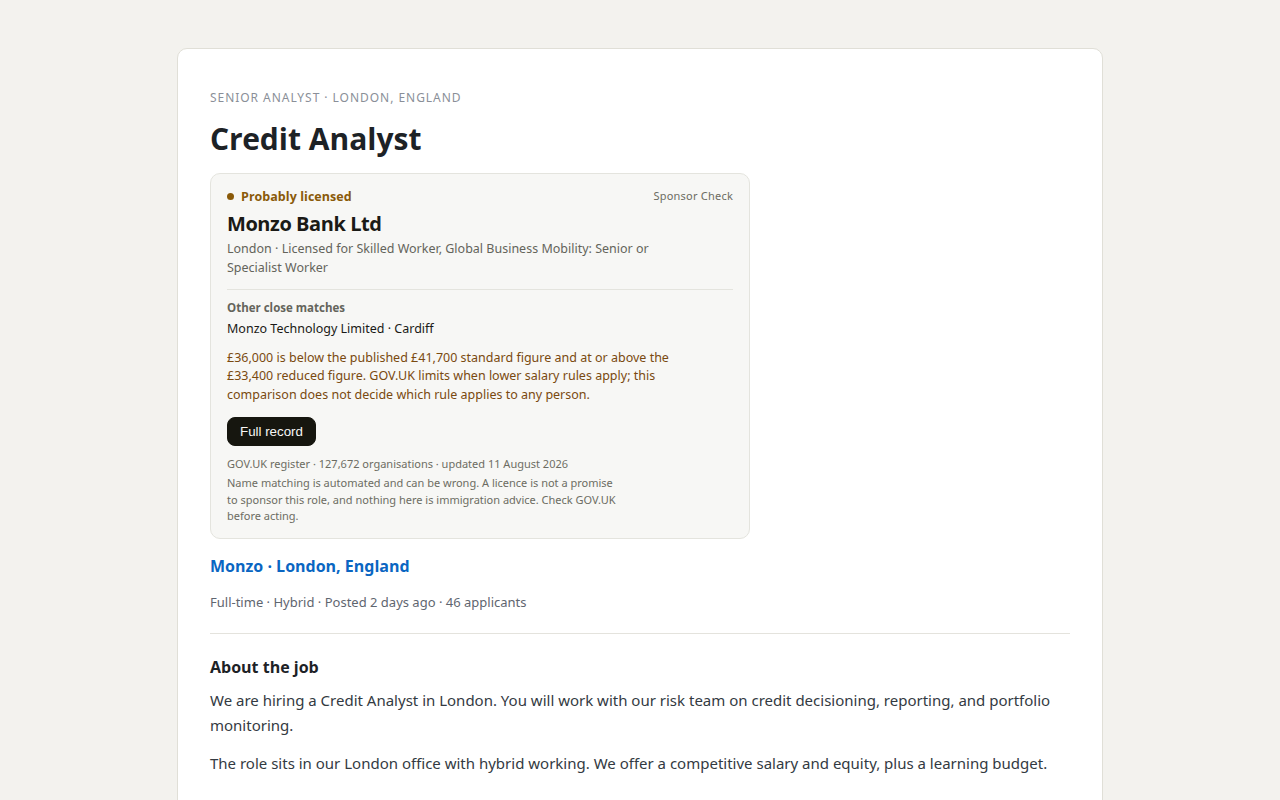
Our product. Sponsor Check is the browser extension sold by THINKINGAI LIMITED, the company identified in this site's footer. The register itself remains free, official, and public. This site is information only, not immigration advice.